
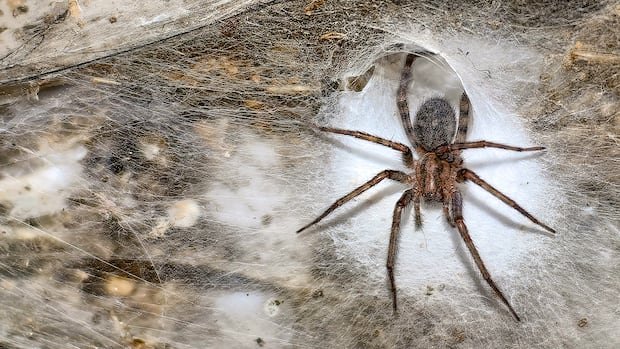

Serban Sarbu, a scientist specializing in caves, made a surprising discovery when he explored the Sulfur Cave on the Albania-Greece border. Inside the cave, Sarbu and his research team found an extraordinary ecosystem hosting over 111,000 spiders entangled in what is believed to be the largest spider web in the world.
The unexpected abundance of spiders in the cave raised questions about how they thrive in such a typically inhospitable environment. This discovery was recently detailed in the journal Subterranean Biology. Sarbu explained that caves are usually devoid of life due to the absence of light necessary for photosynthesis and the scarcity of organic matter for animals to feed on. Creatures dwelling in caves are typically small, blind, and slow to conserve energy.
The remarkable number of spiders in the Sulfur Cave is attributed to the sulfur-rich conditions in the cave, providing an opportunity for microbes to thrive on the chemical energy produced from hydrogen sulfide oxidation. Alongside spiders, the cave also houses various other creatures such as centipedes, scorpions, beetles, bats, and chironomid fly larvae.
The massive spider web found in the cave covers an area of approximately 1,140 square feet, resembling the size of a small home. Sarbu clarified that each spider constructs its individual web, but due to the concentration of food sources, the webs merged over time into a vast layered structure. Despite the appearance of a collective effort, the spiders do not intentionally collaborate in building the web.
Further exploration revealed that two spider species, Tegenaria domestica and Prinerigone vagans, coexist in the cave’s web, with around 69,000 and 42,000 individuals, respectively. This peaceful cohabitation between different spider species is considered rare in the animal kingdom, as larger spiders typically prey on smaller ones. Evolutionary biologist Lena Grinsted highlighted the uniqueness of this phenomenon, emphasizing that spiders usually exhibit cannibalistic behavior when in close proximity.
The attention garnered by this discovery from the public surprised Sarbu, who noted the usual aversion towards spiders. Despite the general fear of spiders, the public’s fascination with the intricate ecosystem within the Sulfur Cave has been remarkable to Sarbu, challenging common perceptions of these arachnids.