
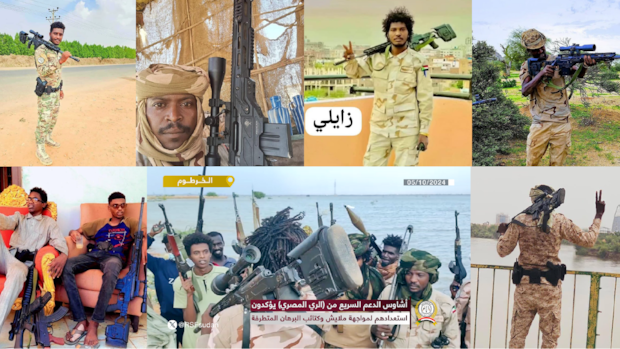

A paramilitary group in Sudan, responsible for civilian massacres, has been found in possession of weapons bearing the logo of a Canadian arms manufacturer, as revealed by CBC’s visual investigations unit. The civil war that commenced on April 15, 2023, has caused significant damage to civilian infrastructure in Sudan, leading to a humanitarian crisis with over 150,000 deaths and more than 12 million internally displaced civilians.
El Fasher, the stronghold of the Sudanese Armed Forces in Darfur, witnessed intense conflict as it fell to the Rapid Support Forces (RSF) on October 26. Disturbing reports of civilian massacres followed this event. CBC verified multiple images showing RSF fighters wielding rifles with the logo of Sterling Cross Defense Systems, a company based in Abbotsford, B.C., known for producing firearms and ammunition.
The CBC team confirmed the authenticity of these images by matching them with emblems and camo designs used in Sudan and the design of the Sterling Cross XLCR rifle. The investigation uncovered additional photos and videos showing the presence of these rifles in Sudan since at least 2023.
Sterling Cross, founded in 2008, has been involved in international arms sales, including contracts with the Canadian government. It has produced the XLCR rifle since 2019, featuring a distinct logo consistent with the rifles seen in Sudan. Despite inquiries about their involvement in Sudan, Sterling Cross refrained from providing specific details, emphasizing alignment with Canadian regulations.
The proliferation of foreign weapons in Sudan, including those from Canada, has raised concerns about the role of international brokers facilitating arms transfers. The United Arab Emirates has been implicated in supplying arms to various factions in Sudan, raising questions about the enforcement of arms export regulations.
Experts emphasize the need for enhanced monitoring mechanisms to ensure accountability in arms exports. Canada’s tracking and monitoring systems, while having strict licensing rules, are deemed insufficient in monitoring weapons once they leave the country, leaving room for opacity in the end-use chain. Calls for improved regulatory measures to address arms export issues have been made to prevent the unauthorized flow of weapons to conflict zones like Sudan.