
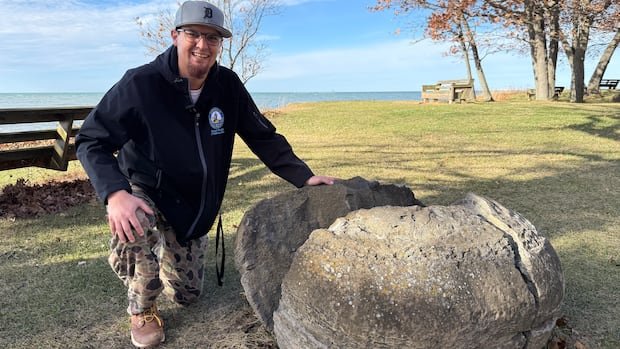

Two ancient stone spheres were brought back to Kettle and Stony Point First Nation on the shores of Lake Huron last Tuesday. These boulders, known as kettles due to their resemblance to cooking pots, are located about 220 kilometers southwest of Toronto. They hold cultural significance for the Anishinaabek people. According to knowledge keepers, Kettle Point beach is considered the nesting ground of the Thunderbird, powerful spirits that provide protection and healing rains to communities in exchange for safeguarding their sacred sites, with the kettles symbolizing their eggs. It is believed that the source of power diminishes if the stones are removed.
Christy Bressette, a member of Kettle and Stony Point and vice-provost for Indigenous initiatives at Western University in London, Ont., played a crucial role in facilitating the return of the kettles from the university’s possession. Bressette emphasized the importance of repatriating sacred items like the Thunderbird eggs to their rightful place, stating that more work lies ahead.
Bressette highlighted the significance of sharing Indigenous knowledge, stating that it offers sustainable solutions that benefit not only Indigenous communities but also society at large. Welcomed back with a pipe ceremony and honor song, the kettles marked a solemn occasion for the Anishnabek people.
Jordan George, language revitalization and communications co-ordinator at Kettle and Stony Point, expressed satisfaction at the return of the kettles while acknowledging that this was just the beginning of the journey to repatriate and care for other stones taken from their shores. Out of the three kettles held by the university, the largest and smallest, along with several fragments, were returned, while one will remain at the university.
Desmond Moser, assistant dean of decolonization in Western’s Faculty of Science, explained that the rocks, calcite concretions, can crack if stored out of water due to rainwater entering through small fractures. He noted that these unique kettles formed around 370 million years ago during the Devonian period. The largest kettle, discovered in the 1990s and used in a teaching rock garden, was returned to its rightful place.
Moser, reflecting on the ceremony, mentioned that it was a learning opportunity for scientists, shedding light on the cultural significance of the kettles and indigenous relationships with rocks and land. David Cloud, a knowledge keeper and council member, shared his childhood desire to see the Thunderbird eggs return home, a dream that finally came true. He recalled learning about the eggs from his grandparents near “the nest” area on the lake and expressed joy that children in the community would soon be taught those valuable teachings at their school.