
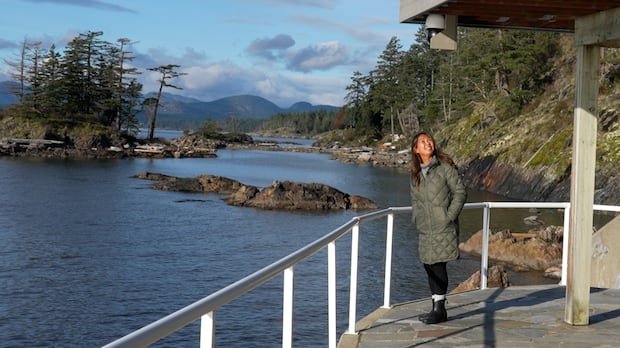

Residents along the coast of British Columbia are generously offering their private properties as hosts for advanced technology aimed at detecting whales to protect these marine mammals. Suzette Alvarez and Marshall Farris, who own an oceanfront property near Halfmoon Bay on the Sunshine Coast, installed a live camera beneath their deck in May 2024. The camera overlooks the Malaspina Strait, while a hydrophone, placed 20 meters deep in the ocean, captures underwater sounds from vessels and marine creatures.
Alvarez emphasized the importance of protecting these magnificent animals, especially in light of recent incidents where three humpback whales were killed and one injured by vessel strikes along the B.C. coast. Working alongside a group of concerned residents, Alvarez and others are supporting the deployment of innovative technology to aid in whale detection and conservation efforts, as noted by scientists.
The Raincoast Conservation Foundation, a non-profit organization comprising conservationists and scientists, manages and analyzes the data collected from the camera and hydrophone. This technology, considered the first of its kind in the region, plays a crucial role in monitoring the presence of endangered marine mammal species by tracking their vocalizations and assessing the impact of human-generated noise from boats and other activities.
According to Valeria Vergara, a scientist affiliated with the foundation, the research focuses on studying the effect of noise pollution on marine mammals, highlighting the significant role noise plays in their habitat. Vergara stressed the urgency of addressing underwater noise pollution, which has emerged as a critical issue in recent decades due to its rapid transmission in water compared to air.
The Southern resident killer whales, an endangered species, are particularly vulnerable to noise pollution, contaminant exposure, and prey availability challenges, according to Vergara. To combat these threats, residents like Chris Roper from Pender Island have stepped up by hosting an infrared thermal camera, known as WhaleSpotter, on their properties. This technology, operated by the W̱SÁNEĆ Marine Guardians, aids in monitoring and advocating for marine animals in the Salish Sea.
The WhaleSpotter system, equipped with thermal imaging and artificial intelligence capabilities, detects whale presence by identifying temperature variations caused by whale blows in real-time. Once an alert is triggered, it is promptly verified by an operator to ensure accurate data transmission. With over 10 cameras strategically positioned across British Columbia, WhaleSpotter offers a science-backed solution to enhance wildlife protection.
These initiatives, alongside traditional monitoring methods and witness reports, provide valuable tools for conservationists and scientists, as explained by Department of Fisheries and Oceans Canada scientist Harald Yurk. Yurk highlighted the potential use of technology to implement speed restrictions, such as reducing vessel speeds to 10-12 knots when whales are detected, thereby mitigating the risk of fatal collisions.
By engaging the public through educational platforms and real-time monitoring, residents like Alvarez aim to foster a deeper connection with these marine creatures, encouraging a shared responsibility for their preservation within the ecosystem.