
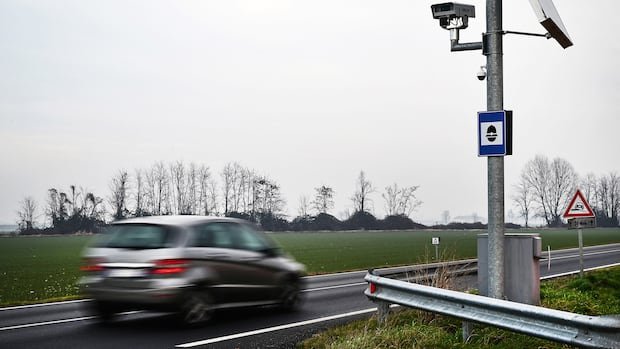

On a cold day in the winter of 2024, residents in a suburban area near Padua, Italy woke up to a surprising sight: a speed camera that had been tampered with using an angle grinder, displaying the message “Fleximan is coming.”
Following numerous imitations of speed camera vandalism, the name Fleximan has gained a legendary reputation in Italy.
Describing Fleximan as a local hero, Tom Roper, an English school proprietor residing in the region for 15 years, mentioned receiving inquiries about Fleximan from curious individuals.
Despite the flamboyant actions of Fleximan, there exists a significant consensus throughout Europe that speed cameras are effective and widely supported.
Jenny Carson, a project manager at the European Transport Safety Council (ETSC) in Brussels, Belgium, stated that public backing for enforcement measures is substantial, with citizens advocating for speed reduction.
Italy, boasting over 10,000 operational speed cameras, the highest in Europe, serves as a testament to this trend. A 2018 European survey revealed that nearly 70 percent of Italians favored stricter speeding regulations, despite almost half admitting to speeding in the past month.
While Ontario Premier Doug Ford has taken a stand against speed cameras, labeling them a money-making scheme and considering banning the technology, it raises the question of how Europe successfully garnered widespread support for automated enforcement systems that could potentially save lives.
In 2002, following a series of high-profile traffic incidents, French President Jacques Chirac pledged to prioritize reducing traffic fatalities. France currently operates over 2,400 cameras, offering valuable insights for Canada on the importance of top-level endorsement for such systems.
According to Laurent Carnis, a traffic safety expert at France’s Université Gustave Eiffel, political commitment plays a crucial role in establishing centralized systems for nationwide enforcement and fines.
France, like other European nations, views speed cameras not only as enforcement tools but also as educational aids. Utilizing fixed and mobile cameras, they focus on prevention and punishment, employing a deterrence theory that has proven effective.
Across Europe, similar systems have led to significant reductions in average speeds and road accidents, preventing an estimated 1,000 lives and numerous injuries, as stated by Carnis.
In Canada, municipalities have reported substantial speed reductions near speed cameras, but experts caution against overlooking minor offenses that may persist post-implementation.
While speed cameras have shown positive outcomes, Carnis warns that indiscriminate targeting may fuel opposition, as witnessed in France where vandalism has damaged a significant portion of the camera network.
To address speeding issues effectively, experts emphasize the importance of setting meaningful speed limits that align with road design and evolving vehicle safety features.
Despite the benefits of speed cameras, opposition persists, exemplified by Deputy Premier Matteo Salvini denouncing the existing system in Italy due to vigilante actions like Fleximan’s.
The wavering support for speed cameras among politicians in Europe indicates a potential shift in sentiment, even as advocates like Roper in Italy continue to endorse the technology as a means to manage reckless driving behavior.