
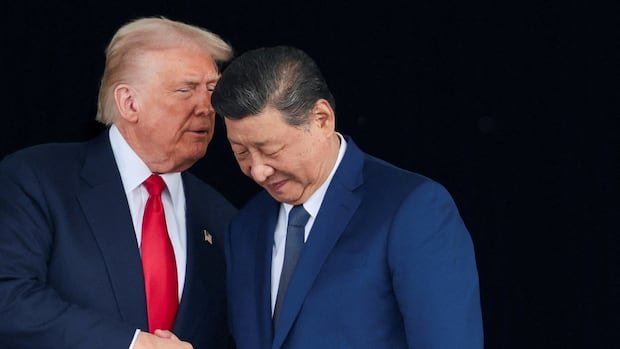

In a recent development, U.S. President Donald Trump announced a mutual agreement with Chinese President Xi Jinping to reduce tariffs on China in exchange for Beijing’s crackdown on the illicit fentanyl trade, recommencing U.S. soybean purchases, and maintaining exports of rare earths. The face-to-face meeting between Trump and Xi in Busan, South Korea, marked the conclusion of Trump’s Asia tour, showcasing trade achievements with South Korea, Japan, and Southeast Asian countries.
Trump expressed satisfaction with the meeting, rating it as exceptional. He disclosed that tariffs on Chinese imports would decrease from 57% to 47%, achieved by cutting the tariff rates for fentanyl precursor drugs from 20% to 10%. Emphasizing China’s commitment to combat the fentanyl crisis, Trump acknowledged their efforts, leading to the tariff reduction.
While the tariff reduction was commended by Trump, only India and Brazil currently face higher tariff rates among major U.S. trading partners. Xi highlighted the need for continued cooperation in a statement issued by the Chinese Commerce Ministry. The world markets had surged before the meeting in anticipation of a resolution to the trade dispute between the two economic giants.
The meeting, held on the sidelines of the Asia-Pacific Economic Cooperation summit, lasted nearly two hours and focused on addressing primary concerns between the U.S. and China. Trump mentioned no immediate response to U.S. concessions but confirmed China’s commitment to purchasing substantial quantities of U.S. soybeans and other agricultural products promptly.
China’s recent purchase of U.S. soybeans, the first in several months, was reported ahead of the summit. Previous trade agreements, reducing retaliatory tariffs and resuming rare earth magnets flow from China, are set to expire soon. Despite the recent expansion of controls on rare earths by Beijing, Trump expressed confidence that China would not impose these restrictions. Additionally, Trump sealed agreements with Japan and Southeast Asian nations to diversify rare earth supplies during his trip.
Notably, U.S. Treasury Secretary Scott Bessent revealed that China agreed to purchase 12 million metric tonnes of American soybeans within the current season until January and committed to acquiring 25 million tonnes annually for the next three years. Furthermore, other Southeast Asian countries pledged to buy an additional 19 million tonnes of U.S. soybeans, as disclosed by Bessent on Fox Business Network.