
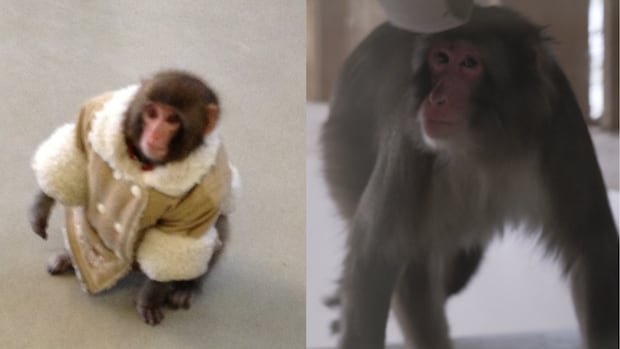

Darwin, the famous monkey from the Toronto Ikea parking lot incident, demonstrates a keen awareness of cameras and quickly evades them within his enclosure. The 13-year-old Japanese macaque, who was discovered as a baby in 2012 at the North York Ikea parking lot clad in a diaper and shearling coat, has since resided at the Story Book Farm Primate Sanctuary in Sunderland, Ont.
Upon Darwin’s arrival at the sanctuary, Executive Director Daina Liepa, who had recently begun volunteering there, noted his unusual behavior of walking on two feet, as Japanese macaques typically move on all fours. She observed that the clothing items found on him seemed ill-fitting for his body.
Liepa believes that Darwin’s early exposure to humans has contributed to his shyness around strangers in adulthood, as he may have been compelled to interact with people against his will. Darwin celebrated his 13th anniversary at the sanctuary this week and now enjoys activities like swinging indoors and indulging in grapes. Liepa plans to introduce him to Chiquita, another Japanese macaque at the sanctuary, to foster companionship.
Story Book Farm is Canada’s sole primate sanctuary, currently housing 24 monkeys and lemurs at full capacity. Nonetheless, the Fauna sanctuary in Quebec accommodates various animals, including primates. Liepa shared that the sanctuary recently had to refuse two monkeys due to lack of space, marking the first time they had to turn animals away. When new primates are accepted, they often require immediate medical attention upon arrival.
Camille Labchuk, an animal rights lawyer and executive director of Animal Justice, emphasized the heavy responsibility that sanctuaries like Story Book bear in caring for exotic animals seized from various situations, including zoos and wildlife trade. Labchuk advocates for stricter provincial laws in Ontario to curb the exotic animal trade, estimating that the province has likely trafficked “hundreds of thousands” of primates, birds, reptiles, and other species.
The sanctuary heavily relies on fundraising efforts to sustain its operations, with ongoing plans for a million-dollar campaign to expand facilities for more monkeys. Liepa expressed the desire for sanctuaries like Story Book not to be necessary, emphasizing that the animals under their care did not choose captivity and often spend their entire lives in sanctuaries due to the lack of alternatives.