
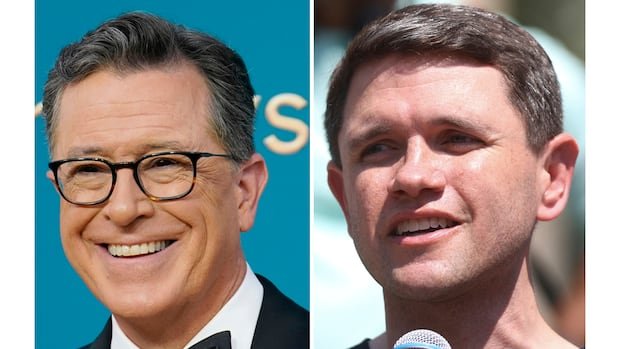

Late-night talk show host Stephen Colbert revealed that his planned interview with Democratic Texas Senate candidate James Talarico was excluded from Monday’s broadcast due to concerns from the network about potentially breaching regulatory guidelines set by the Trump administration regarding equal time for political candidates.
This issue arose just before the commencement of early voting in the Texas primary elections, where competitive Senate nomination races are taking place across party lines.
During his show, “The Late Show with Stephen Colbert,” Colbert disclosed, “He was meant to be our guest, but our network’s legal team directly informed us that we could not have him on the show.” Additionally, Colbert mentioned, “I was instructed not only to refrain from having him on the show but also not to mention his absence. Since discussing this matter is discouraged by my network, let’s delve into it.”
Contrary to Colbert’s statement, CBS refuted the claim and clarified that the decision was based on legal advice indicating that featuring Talarico on the show might trigger the FCC equal-time rule.
Talarico is engaged in a competitive race for the Democratic nomination amid shifting broadcast guidelines under the Trump administration that dictate how media outlets engage with political candidates. His main rival is U.S. Rep. Jasmine Crockett, with both candidates gaining national recognition through viral social media content.
On the Republican side, incumbent Sen. John Cornyn faces a tough political battle against Texas Attorney General Ken Paxton and U.S. Rep. Wesley Hunt. Paxton escalated his campaign with a rally in Tyler, Texas, on Monday evening.
Talarico shared a brief clip of his interview with Colbert online, labeling it as “the interview Donald Trump didn’t want you to see.” He is scheduled to hold a rally in Austin on Tuesday evening.
Broadcast networks have traditionally been required to provide equal time to political candidates, although this rule has not typically applied to talk shows. Earlier this year, the FCC issued new guidelines cautioning late-night and daytime hosts to ensure equal time for political candidates, with FCC chair Brendan Carr questioning the exemption granted to talk shows and suggesting potential partisan motivations behind the hosts’ actions.
Colbert noted that while the equal time rule applies to broadcast platforms, it does not extend to streaming services. Consequently, his interview with Talarico was exclusively posted on the show’s YouTube channel, emphasizing that it was not aired on television.
As Colbert faces an impending exit from his hosting role following CBS’ decision to cancel his show in May, questions have been raised about the timing of the announcement, particularly following Colbert’s critical remarks on a settlement involving Trump and the parent company of CBS. This move drew scrutiny from two U.S. senators who questioned the underlying motives behind the cancellation, which effectively removed one of Trump’s prominent late-night critics from the airwaves.