
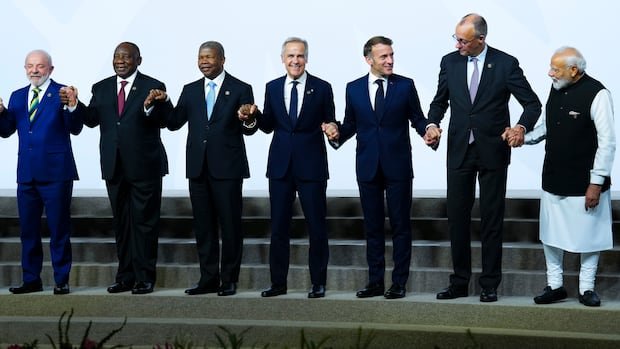

Leaders at the G20 summit in South Africa expressed concerns about the group’s future amid increasing geopolitical tensions and a rapidly changing global landscape. Established in the late 1990s, the Group of 20, co-founded by former Prime Minister Paul Martin, has convened annually since 2008 to address international economic and financial stability.
The G20 symbolizes the pinnacle of multilateralism, emphasizing the idea of nations collaborating and compromising for the collective good. However, significant shifts have occurred over the past two decades. French President Emmanuel Macron warned that the G20 might be approaching the end of its current phase, citing challenges in resolving major crises collectively.
The global order’s upheaval, as described by Prime Minister Mark Carney, is largely attributed to the United States and President Donald Trump’s policies. Trump’s trade disputes with numerous nations and his transactional approach to global conflicts, such as the situation in Ukraine, have steered G20 members towards prioritizing economic security over cooperation.
Even China, often criticized for destabilizing global security, expressed apprehensions about the future amid rising unilateralism and protectionism. Leaders, including Finland’s President Alexander Stubb attending the G20 for the first time, echoed concerns over the diminishing role of multilateralism and the increasing focus on deals leading to potential conflicts.
President Trump’s absence at the summit raised questions about global unity. Nonetheless, the remaining nations showed solidarity, exemplified by the consensus declaration adopted at the summit’s outset. This unity was highlighted by Foreign Affairs Minister Anita Anand, emphasizing the significance of formal and informal discussions among leaders.
The G20 meeting without U.S. representation underscored the need for like-minded nations to strengthen trade, investment, and security alliances. Carney highlighted that the G20 countries represent a substantial portion of global GDP and trade, emphasizing a transition towards a better future rather than nostalgia-driven strategies.
During the summit, Canada secured a significant $90 billion investment from the U.A.E., with a substantial portion allocated to specific projects. Carney also initiated discussions on a new investment pact with South Africa and commenced negotiations for a trade deal with India, aiming to diversify Canada’s trade partners.
Carney’s efforts to bridge the Pacific Rim and EU blocs through discussions with European Commission President Ursula von der Leyen and Vietnam’s Prime Minister Phạm Minh Chính were geared towards enhancing trade, investment, and partnerships across various sectors, including AI and energy.
Despite the challenges posed by the changing global landscape, advocates for global cooperation believe that multilateralism is evolving rather than disappearing. Carney envisions a future where middle powers like Canada play pivotal roles in inclusive multilateral arrangements that benefit all parties involved.