
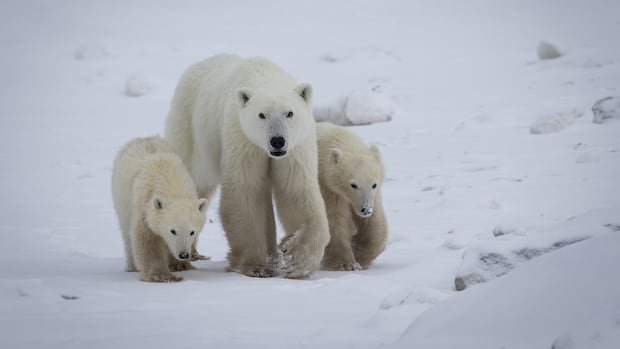

In northeastern Manitoba, researchers tracking polar bears were surprised to witness a rare event involving a polar bear mother and her cub. During a recent expedition near Churchill, scientists observed the mother with an additional cub, which was confirmed not to be her biological offspring. This incident marked the 13th recorded case of cub adoption within the western Hudson Bay subpopulation.
Alysa McCall, the director of conservation outreach and a staff scientist at Polar Bears International, expressed a mix of emotions upon confirming the adoption, emphasizing the remarkable nature of polar bears and their capacity for compassion towards one another.
Evan Richardson, a polar bear research scientist with Environment and Climate Change Canada, recounted the encounter when his team initially spotted the mother bear with only one cub in Wapusk National Park. Subsequently, in November, the researchers were astonished to find the family had expanded to include a third cub, with two of the bears equipped with GPS tracking collars.
The mother bear, estimated to be around five years old, along with the two cubs aged approximately 10-11 months, caught the researchers’ attention. Richardson proposed that the mother’s strong maternal instincts likely led to the adoption of the lone-roaming cub, underscoring the nurturing nature of polar bears.
While the exact reason for the adoption remains uncertain, McCall highlighted the critical role maternal care plays in the survival of polar bear cubs, noting that the adopted cub now stands a better chance of reaching adulthood. Richardson expressed hope that genetic data obtained from the cub will provide insights into its origins.
The researchers emphasized the importance of monitoring and protecting polar bear populations, particularly in the face of challenges posed by climate change. Richardson underscored the significance of female bears adopting and caring for additional cubs as a positive development for the bears in Churchill.
Collaborating with organizations like Polar Bears International and the University of Alberta’s polar bear science program, Environment and Climate Change Canada continues to collect valuable data on polar bear populations using GPS collars. Such initiatives aid in tracking the movements and behaviors of these iconic Arctic creatures, contributing to conservation efforts.
In conclusion, the rare sighting of a polar bear mother adopting a second cub serves as a reminder of the remarkable nature of these animals and the need to safeguard their future amidst changing environmental conditions.