
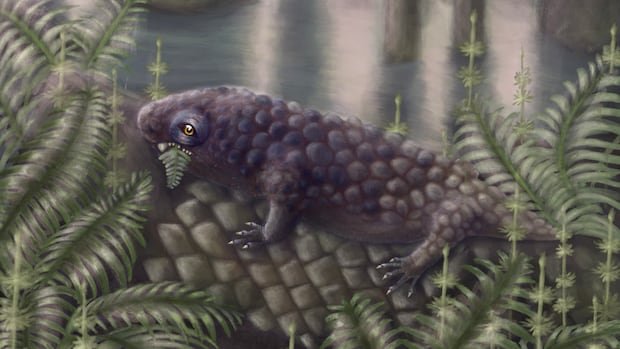

A recently discovered creature, roughly the size of a football, with the ability to chew plant material extensively, potentially stands as one of the earliest herbivorous vertebrates on record. Named Tyrannoroter heberti, this species thrived approximately 307 million years ago in a lush, fern-filled swamp on Cape Breton Island in Nova Scotia during the late Carboniferous Period. During this era, most tetrapods primarily consumed other animals as they had not yet evolved the capability to consume and digest plant matter such as leaves and bark.
According to a recent study detailed in Nature Ecology and Evolution, Tyrannoroter heberti represents the earliest known quadruped with teeth suited for a plant-based diet, challenging previous notions regarding the pace of this dietary transition. Arjan Mann, the lead author of the study, highlighted the significance of this finding in reshaping our understanding of vertebrate evolution.
Belonging to a group known as “microsaurs,” Tyrannoroter was a diminutive, reptile-like creature predating the existence of reptiles and mammals. Its skull, among several fossils entangled in the roots of an ancient, petrified tree stump on Cape Breton Island, was unearthed by award-winning amateur paleontologist Brian Hebert. The species name, heberti, pays homage to his discovery.
Mann, a paleontologist at the Field Museum of Natural History in Chicago, explains that Tyrannoroter’s skull closely resembles that of pantylids, a group of microsaurs characterized by short, stout bodies adapted for digging. Despite the typically diminutive size of pantylids, Tyrannoroter is estimated to have been much larger, roughly the size of a football, earning it the moniker “tyrant digger.”
The standout feature of Tyrannoroter is its multiple rows of uniquely shaped teeth resembling Hershey’s Kisses, specifically designed to consume shoots, leaves, and fibrous plant material. These teeth, while reminiscent of those found in insect-eating animals, possess additional rows or “batteries” that enhance their grinding capacity.
The study of previously discovered fossils revealed relatives of Tyrannoroter dating back as far as 318 million years, indicating an early adaptation towards a plant-based diet within this animal group. This dietary shift was crucial as tetrapods initially colonized land about 375 million years ago, at the dawn of the Devonian Period, when plants had already established dominance on land. However, the lack of suitable teeth and digestive capabilities hindered tetrapods from consuming plant material until later evolutionary developments.
Mann and his team suggest that early herbivores like Tyrannoroter may have acquired cellulose-digesting capabilities by feeding on insects, paving the way for the eventual consumption of plant matter. The researchers speculate that the broad, robust bodies of pantylids might indicate the presence of cellulose-digesting microbes in their digestive tracts.
These findings not only shed light on the ancient origins of herbivory but also hold significance for evolutionary studies. The presence of herbivores in ecosystems has a profound impact on plant life, making understanding their emergence crucial for comprehending ecological dynamics over time.