
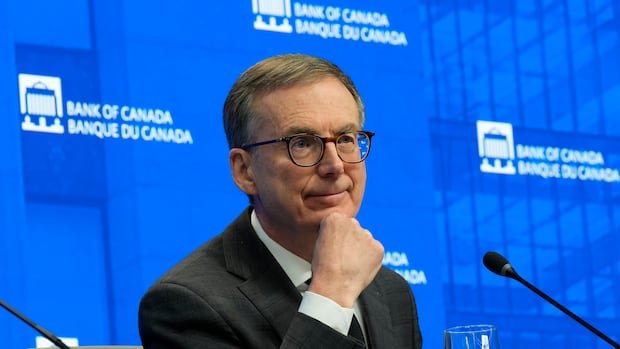

The Bank of Canada has decided to maintain its benchmark interest rate at 2.25 percent for the second consecutive meeting, with potential changes looming due to ongoing trade uncertainties with the U.S. and Mexico. Governor Tiff Macklem stated that the bank’s economic outlook has not significantly altered since its previous projection in October. However, he highlighted increased uncertainty and a wider range of potential outcomes, citing unpredictable U.S. trade policies and heightened geopolitical risks.
The upcoming review of the Canada-U.S.-Mexico Agreement (CUSMA) presents a crucial economic uncertainty and a significant risk to Canada’s economic forecast, according to Macklem. He emphasized the shift from open, rules-based trade with the U.S., indicating the need for Canada to adapt to this new reality.
Macklem also noted that efforts to diversify trade may not fully counter the “structural” damage caused by the U.S. trade dispute. The central bank’s economic projections are based on scenarios where U.S. tariffs against Canada remain and CUSMA-related exemptions allow for some free trade with the U.S. However, these projections could change based on the outcome of the CUSMA review.
Concerns over the independence of the U.S. Federal Reserve are contributing to heightened economic uncertainty in Canada and globally, Macklem highlighted. He voiced support for U.S. Fed Chair Jerome Powell amid pressures to cut interest rates, emphasizing the importance of a functional and independent Federal Reserve for global economic stability.
Economist Joseph Brusuelas suggested that interest rates are unlikely to change further this year, but the upcoming CUSMA review could lead to contentious outcomes. Any policy adjustments by the central bank may lean towards rate cuts if economic growth falters or if there are significant disruptions in U.S. economic relations.
Looking ahead, the Bank of Canada anticipates modest GDP growth in 2026-27, with the inflation rate expected to remain near the two percent target. While U.S. tariffs continue to impact Canadian exports, domestic spending shows signs of improvement. Business investment, which had slowed due to uncertainties, is projected to pick up.
Despite recent employment gains, Canada’s unemployment rate remains high at 6.8 percent, with few businesses planning to increase hiring in the near future. The central bank projects annual average GDP growth of 1.1 percent in 2026 and 1.5 percent in 2027, aligning with previous projections.
Governor Macklem reiterated that the current interest rate is appropriate to keep inflation in check, but the bank stands ready to adjust its stance based on evolving economic conditions. Analysts suggest that the central bank’s inclination leans towards concerns about economic growth due to trade uncertainties and easing underlying inflation, with a potential for rate cuts rather than hikes in the future.