
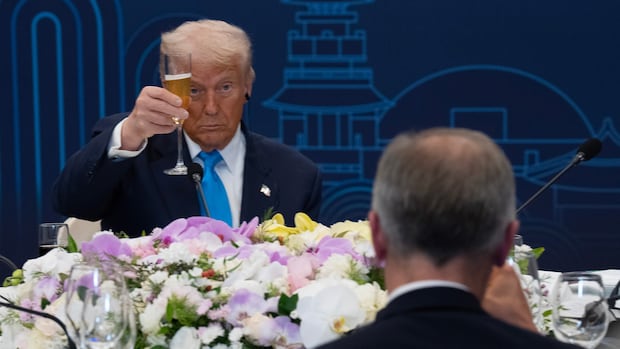

During a dinner preceding the Asia-Pacific Economic Co-Operation Summit on Wednesday, U.S. President Donald Trump and Prime Minister Mark Carney were positioned across from each other and even raised their glasses in acknowledgment.
However, it was evident that the two leaders had little to discuss, showcasing the chill that has settled over U.S.-Canada relations.
This meeting marked the first in-person encounter since Trump halted trade discussions due to an anti-tariff advertisement aired by the Ontario government.
Following the dinner, in response to a question shouted by a journalist from Global News, Carney stated he had “very good conversations with all the presidents” present.
Upon arriving in South Korea, Carney faced the stark reality of tensions with the U.S., as Air Force One was visible on the tarmac in front of his aircraft.
As Canada heads into the APEC meeting, it seems to be caught in a difficult position, with Carney aiming to redefine the nation’s relationship with China.
On one side, there is a visibly declining rapport with Trump, who has opted not to engage with Carney and previously canceled trade discussions. On social media, Trump expressed his reluctance to discuss matters with Canada while in South Korea.
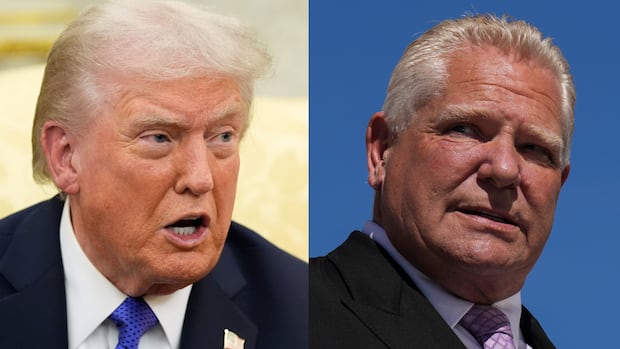
U.S. President Donald Trump announced he would be terminating all trade negotiations with Canada after an anti-tariff ad by the Ontario government was broadcast to American audiences. In response, Ontario Premier Doug Ford said he will pull the ad Monday, after it airs during the weekend’s World Series games.
Meanwhile, Carney finds himself in the challenging position of trying to expand trade, which necessitates dialogue with Beijing, the world’s second-largest economy and a significant competitor to the U.S.
Any compromises Canada might consider to mend ties with China—such as reevaluating electric vehicle tariffs—will likely face intense scrutiny or outright opposition from Washington.
The China conundrum
Trump seems poised to approach APEC ready to negotiate trade concessions, or at least modify tariffs, in pursuit of a broader agreement with China.
The extent to which Carney can pursue similar moves remains uncertain.
Ahead of Trump’s scheduled meeting with Chinese President Xi Jinping, reports from the U.S. suggest Washington may be willing to lower tariffs on Chinese goods in exchange for China agreeing to enforce stricter regulations on fentanyl precursor chemicals.
One analyst advised caution regarding the pre-summit buzz, noting that, as demonstrated by Canada, the U.S. trade landscape can shift unexpectedly.
“Trump personally has a favorable view of Xi, so I anticipate a lot of hype following this meeting suggesting that the U.S.-China relationship is improving,” remarked Jonathan Berkshire-Miller, a principal at Pendulum Geopolitics Advisory.
“I would be very wary of believing that, as circumstances could drastically change just days or weeks later, leading to a more negative trajectory in U.S.-China relations.”
In his discussions with Xi on Friday, Carney must tread carefully to avoid aggravating Trump or overlooking the fact that China often operates outside conventional geopolitical norms, Berkshire-Miller noted.
“I’m not suggesting our policies should be dictated by the U.S., but if any significant outcome from that meeting focuses on eliminating the EV tariffs as a reciprocal gesture, it could appear remarkably weak from our perspective,” Berkshire-Miller suggested.
Ottawa imposed tariffs on Chinese electric vehicles at the request of the U.S., which in turn faced retaliatory tariffs from China on Canadian canola.
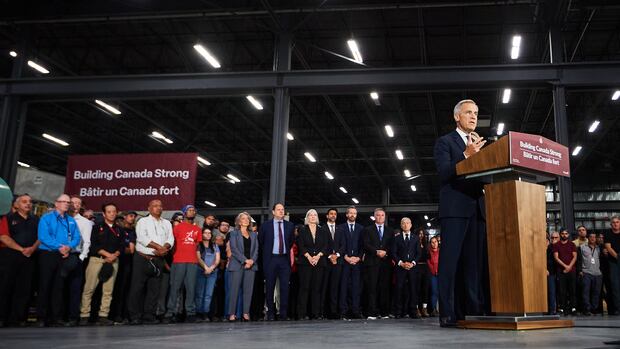
Prime Minister Mark Carney said his government is taking a series of measures to increase Canada’s ‘climate competitiveness’ across the economy, and that includes a broad ‘restructuring’ of the auto sector. He said it’s too early to say if tariffs on Chinese EVs would be removed.
“China approaches its foreign policy tools differently than we may perceive them, and the moment they believe they need to utilize any of those economic strategies, they will do so in ways that could be detrimental to our interests.”
Summit a ‘great opportunity’ for Carney
When asked earlier in the week about the anticipated meeting with China, Carney tempered expectations for a significant breakthrough.
The U.S. won’t be the only entity scrutinizing Carney’s approach to the meeting with Xi. Other Indo-Pacific allies, many of whom he engaged with earlier in the week at the Association of Southeast Asian Nations (ASEAN) summit, will also be observing closely.
Skepticism exists in many Asian capitals regarding Canada’s genuine commitment to diversifying trade away from the U.S. There are also concerns about how improving relations with China could influence not only trade but also their increasing demand for security assurances.
“The region is seeking more than just trade,” noted Berkshire-Miller.
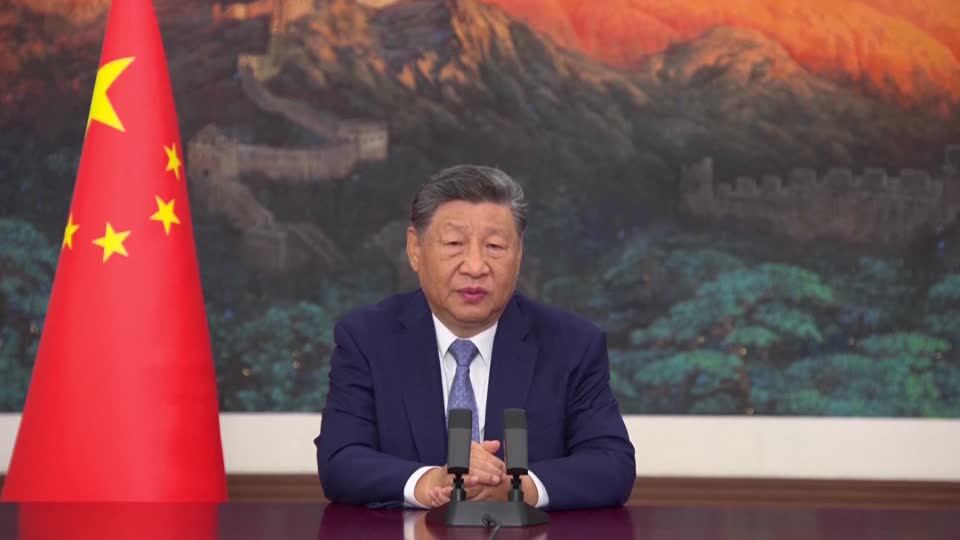
Chinese President Xi Jinping is seen at a United Nations climate summit in September. Canadian Prime Minister Mark Carney is expected to meet with Xi at the Asian economic summit on Friday. (Reuters)
To emphasize this point, South Korea’s acting ambassador to Canada recently remarked in an interview with Radio-Canada that Carney’s visit, which will include a stop at the Hanwha Ocean shipyard—one of the contenders for Canada’s submarine replacement program—signals a strong commitment.
“It’s also a significant opportunity for Prime Minister Carney to reaffirm and underscore Canada’s dedication to the Asia Pacific and its partnership with Korea,” stated Young-gi Ahn, the Korean chargé d’affaires in Ottawa.
“Amid heightened global challenges and geopolitical uncertainties, Korea and Canada require each other’s support. We can be reliable partners.”
While Carney has engaged his network of high-level business contacts in the region over recent days—securing meetings with Singapore’s prime minister, the CEO of Petronas, and the chairman of Temasek Holdings, a leading private equity firm—the U.S. and China have rushed to establish new agreements or bolster their trading connections in the area.
Trump has executed numerous agreements with various countries to ensure access to rare earth minerals, an essential sector dominated by China, crucial for advanced manufacturing.
Multiple agreements of varying scopes were concluded with Japan, Malaysia, Thailand, Vietnam, and Cambodia. This effort is a strategic move to reduce reliance on China prior to Trump’s meeting with Xi.
Two days after Trump departed from the ASEAN summit, China announced an upgraded free trade agreement with a coalition of 11 countries. This agreement will enhance collaboration in areas such as transportation, digital trade, green economy, sustainability, and disaster prevention, among others.