
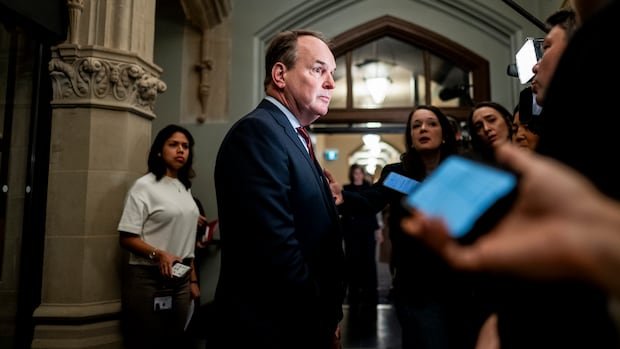

Liberal House leader Steve MacKinnon expressed concerns on Tuesday about the potential lack of opposition support for the government’s upcoming budget, while also dismissing certain demands put forth by other parties. The Liberal government will require the backing of at least one opposition party to pass the budget, which is set to be presented on November 4. Failure to secure budget approval could trigger a new election.
MacKinnon highlighted his unease, stating, “When I see opposition parties ruling out the possibility of voting for the budget, that’s starting to worry me.” Opposition parties have begun outlining their priorities for the forthcoming budget.
Conservative Leader Pierre Poilievre recently urged Prime Minister Mark Carney to deliver an “affordable budget” featuring wide-ranging tax cuts and maintaining the deficit below $42 billion. In contrast, the Bloc Québécois specified six key budget priorities, including increased federal health transfers to provinces, new infrastructure investments, expansion of the rapid housing initiative, interest-free loans for first-time homebuyers, and enhanced Old Age Security (OAS) payments for individuals aged 65 to 75.
Despite expressing concerns about garnering support for the budget, MacKinnon dismissed the demands of both the Conservative and Bloc parties, describing them as unreasonable. He emphasized the government’s commitment to presenting a plan to address the current critical juncture in history.
Responding to MacKinnon’s remarks, NDP interim Leader Don Davies emphasized that it is the government’s responsibility to rally support for its budget. Davies stated, “The question of whether there is an election is entirely up to Mr. Carney. As a leader of a minority government, it’s his duty to craft a budget capable of securing backing from at least one opposition party.”
The NDP, despite having only seven seats following the April election, holds sufficient influence to impact the budget vote. Davies underlined the importance of cross-party collaboration, highlighting that the government should engage with all parties to ensure budget approval.
Carney has hinted at a larger deficit this year compared to the previous year, with the Liberals pledging to balance operational spending within three years. The Parliamentary Budget Officer’s recent report projected an annual deficit of $68.5 billion for this year, excluding plans to increase defense spending gradually to meet NATO benchmarks and reduce public service expenditures over the next three years.