
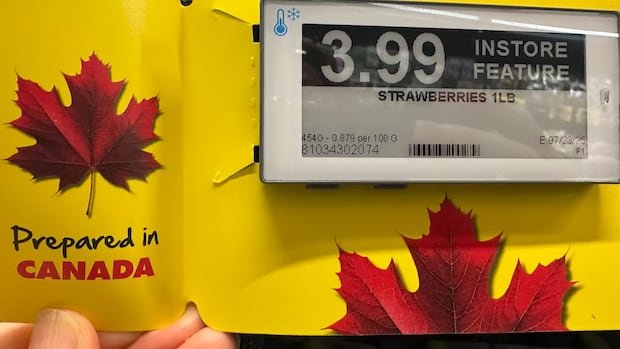

Canada’s food regulator has imposed a $10,000 penalty on a Loblaw-owned establishment for incorrectly marketing imported goods as Canadian products. The Canadian Food Inspection Agency (CFIA) informed CBC News that a Toronto Superstore used “maple leaf advertising decals” and a “Product of Canada” statement in an in-store exhibit to promote a foreign item, leading to consumer confusion regarding its origin. The fine was issued on January 15 but was only announced this week.
The CFIA has the authority to levy fines of up to $15,000 per violation. Neither the federal agency nor Loblaw disclosed the specific product that triggered the penalty. The Superstore in question is situated on Gerry Fitzgerald Drive in the city’s north end. Loblaw acknowledged the complexity of ensuring accurate country-of-origin labels, especially when managing extensive inventory, and expressed regret for any resulting confusion.
The surge in the buy-Canadian movement, which gained traction in response to U.S. President Donald Trump’s trade disputes and remarks about Canada, spurred grocers to leverage Canadian branding to promote domestic products, albeit inaccurately at times. The CFIA’s decision to penalize the Superstore follows a CBC News investigation last summer that exposed major grocers misrepresenting imported goods as Canadian, a practice referred to as “maple washing.”
Federal regulations mandate that food labels and in-store signage must be truthful and not deceptive. Instances of inaccuracies included a Toronto Sobeys falsely advertising raw almonds with Canadian labeling and a Loblaw-owned Toronto No Frills showcasing strawberries with misleading Canadian-themed signage. Despite the CFIA identifying numerous “maple washing” cases, shoppers expressed frustration in September over the agency’s failure to penalize grocers.
The CFIA emphasized its commitment to combatting food mislabelling and tailoring enforcement actions based on various factors such as risk levels, compliance history, and the company’s responsiveness to rectifying issues. The agency has yet to address inquiries regarding why fines were not imposed on Sobeys after a mislabeling incident last April involving avocado oil. Sheila Young, who raised concerns about the avocado oil mislabeling, urged the CFIA to enforce penalties promptly in such situations.
According to CFIA guidelines, “Product of Canada” signifies that a food item is entirely or predominantly produced in the country, while “Made in Canada” requires the final significant transformation of the product to occur within Canada.