
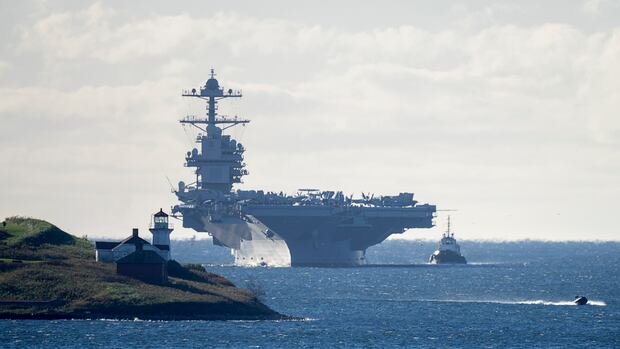

The Pentagon declared on Friday that the U.S. military will dispatch an aircraft carrier to the South American waters, escalating its military presence in a region where the Trump administration has intensified strikes against suspected drug-carrying vessels. Defense Secretary Pete Hegseth has directed the USS Gerald R. Ford and its accompanying strike group to head to the U.S. Southern Command area to enhance the U.S.’s capability in detecting and disrupting illicit activities that threaten the nation’s security and well-being, as stated by Pentagon spokesperson Sean Parnell on social media.
The USS Ford, with a strike group comprising five destroyers, is currently stationed in the Mediterranean Sea. According to a source familiar with the operation, one destroyer is positioned in the Arabian Sea, another in the Red Sea, and as of the latest update, the aircraft carrier was docked in Croatia on the Adriatic Sea. The timeline for the strike group’s arrival in South American waters and the participation of all five destroyers in this deployment remains undisclosed.
The deployment of an aircraft carrier will significantly bolster resources in a region already witnessing a substantial U.S. military buildup in the Caribbean Sea and off the coast of Venezuela. The recent deployment and increased frequency of U.S. strikes, including one conducted recently, have sparked speculation about the extent of the Trump administration’s operations targeting drug trafficking and potential actions against Venezuelan President Nicolas Maduro, who faces charges related to narcoterrorism in the U.S.
Currently, over 6,000 sailors and Marines are stationed on eight warships in the region, with the potential arrival of the entire USS Ford strike group adding nearly 4,500 more sailors along with nine aircraft squadrons assigned to the carrier. The situation is further complicated by Tropical Storm Melissa, lingering in the central Caribbean and forecasted to intensify into a hurricane soon.
Before the official announcement from Parnell, Hegseth disclosed that the military had conducted its 10th strike on a suspected drug-carrying vessel, resulting in six casualties and bringing the total death toll from these operations, initiated in early September, to at least 43 individuals. Hegseth revealed that the targeted vessel was connected to the Tren de Aragua gang, marking the second instance where the Trump administration has associated its actions with the gang originating from a Venezuelan prison.
The frequency of these strikes has escalated from sporadic occurrences to three strikes within a week. Recent strikes in the eastern Pacific Ocean have broadened the operational area, focusing on regions where significant cocaine trafficking occurs, notably from major producers like Colombia. In response to escalating tensions, the Trump administration imposed sanctions on Colombian President Gustavo Petro and his associates over alleged involvement in the global drug trade.
Maduro has interpreted the U.S. military activities as attempts to destabilize his government. He recently commended the security forces and civilian militia for conducting defense drills along Venezuela’s extensive coastline, preparing for potential U.S. threats. The U.S. military’s presence in the region is perceived as a strategic message to align regional countries with U.S. interests rather than solely targeting drug-related activities, according to Elizabeth Dickinson, a senior analyst at the International Crisis Group specializing in the Andes region.