
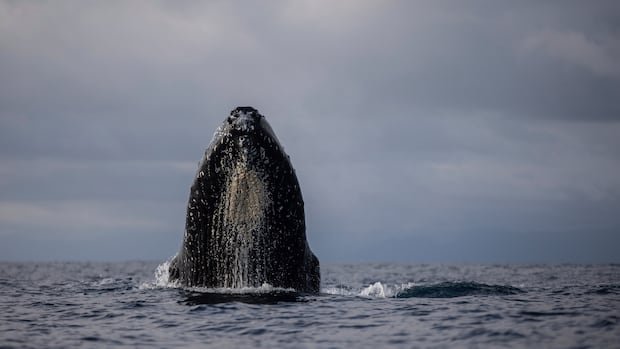

A bioacoustician named Eduardo Mercado was captivated by the mesmerizing sounds of humpback whale songs when he first encountered them. Unlike the prevailing belief among scientists that these songs were mating calls, Mercado considered the possibility of humpbacks using their songs for echolocation, similar to dolphins. This curiosity sparked his lifelong dedication to unravel the true purpose behind these enchanting melodies.
Mercado, a professor at the University of Buffalo’s psychology department, has compiled his extensive research spanning decades into a new book titled “Why Whales Sing.” In a discussion with host Bob McDonald on “Quirks & Quarks,” he delves into the intriguing world of whale communication.
Whale songs differ from human or bird songs as they do not have a distinct beginning or end. Baleen whales, including humpbacks, produce continuous sounds for hours, cycling through fixed patterns in a repetitive manner, resembling an acoustic carousel.
Challenging the conventional notion that whales sing for courtship display, Mercado proposes in his book that these songs are a sophisticated form of echolocation, akin to bats but on a larger spatial scale. Rather than performing for other whales, he suggests that whales use their songs to explore and create an internal map of their surroundings.
While many scientists believe that whale songs serve as courtship rituals due to observations of male whales predominantly singing during breeding periods, Mercado’s research indicates a different perspective. He noticed a dynamic nature in the sounds of whale songs over time, suggesting a form of communication beyond mere display or mating signals.
Drawing parallels between dolphin echolocation and whale behavior, Mercado’s studies led him to believe that whales could be using their songs for sonar purposes. Through experiments and analyses, he demonstrated the physical feasibility of whales detecting objects or other whales several kilometers away using their vocalizations.
Whale sounds, especially from humpback whales, can travel vast distances underwater, reaching up to 10 kilometers and sometimes even 100 kilometers. The purpose of their loud sounds is not to cover long distances but to make the echoes detectable within a certain range, aiding in their echolocation abilities.
Analyzing the acoustic characteristics of whale sounds, Mercado suggests that whales focus on large moving targets, possibly other whales, in their environment. Given the nomadic nature of whales and their solitary lifestyles, these sounds may help them monitor and interact with distant individuals in the vast ocean expanse.
In conclusion, Mercado’s research sheds light on the complex and fascinating world of whale communication, challenging traditional views and offering a new perspective on the true nature of whale songs.