
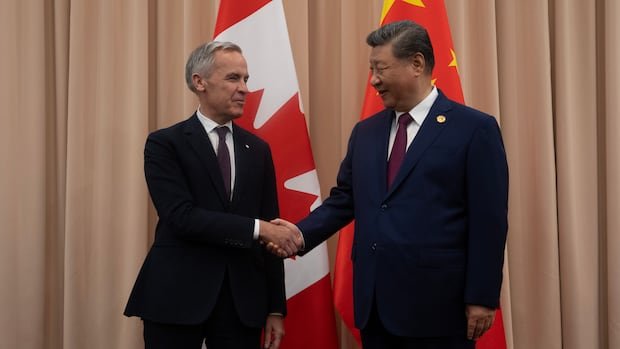

Prime Minister Mark Carney is currently attending the G20 summit in South Africa this weekend, with the notable absence of the world’s largest economy. This event underscores the shifting dynamics in global politics, as evidenced by recent actions taken by U.S. President Donald Trump.
Amidst a backdrop of an increasingly uncertain relationship with the U.S., Canada is taking steps to broaden its international partnerships. In particular, the country is strategically pivoting towards China, recognizing the need to navigate potential risks while bolstering its internal strength.
Prime Minister Carney has initiated groundwork for this shift, exemplified by his recent meeting with Chinese President Xi Jinping during the Asia-Pacific Economic Cooperation summit in South Korea. Describing the encounter as “long overdue” and a pivotal moment in their relationship, Carney aims to double Canada’s non-U.S. exports over the next decade, despite entering the Chinese market later than some other nations.
While China stands as Canada’s second-largest trading partner after the U.S., the $30 billion in Canadian exports to China in 2024 represents only a small fraction of the country’s total exports. With approximately 75% of Canadian exports currently directed to the U.S., there is substantial room for growth in diversifying trade relationships.
Efforts to enhance trade with China may involve resolving ongoing trade disputes, such as Canada’s review of imposing tariffs on Chinese electric vehicles and China’s counter-tariffs on Canadian goods like canola and seafood. Streamlining trade barriers could pave the way for increased collaboration and economic benefits for both nations.
Beyond trade, opportunities for cooperation extend to research and development, manufacturing, and services sectors. Recognizing China’s technological advancements, there is a call to align with Chinese expertise rather than compete fruitlessly, especially in areas like electric vehicle battery production.
In addition to economic ties, soft power initiatives, such as educational exchanges and tourism collaborations, can strengthen bilateral relations between Canada and China. These efforts can help foster mutual understanding and create new avenues for cooperation in various sectors.
As Canada navigates this evolving landscape, analysts emphasize the importance of maintaining a balanced approach. Acknowledging the differences in governance and potential challenges, policymakers need to carefully consider all factors, including human rights and cybersecurity issues, as they shape a comprehensive strategy for engaging with China.