
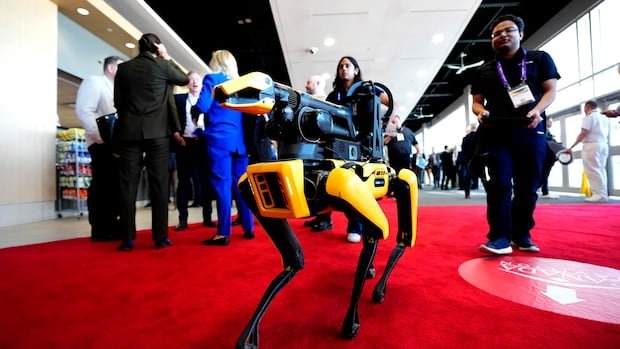

A competition is currently happening worldwide to integrate robotics into our daily routines, with a new wave of AI-driven robots offering enhanced adaptability. The rapid progress in artificial intelligence has led to robots being utilized in various tasks, from collaborating with humans in warehouses to delivering packages on urban streets and exploring hazardous locations.
Moreover, robots are now increasingly capable of acquiring knowledge while on duty, and experts warn that Canada could lose out if we fail to embrace this adoption at this crucial juncture. The current buzzword in artificial intelligence is “physical AI,” which was prominently featured at the recent Consumer Electronics Show (CES).
The concept suggests that physical systems equipped with sensors – such as robots, autonomous vehicles, or industrial machinery – can operate logically and responsively in the real world when combined with existing AI techniques. At CES, Google and American robotics firm Boston Dynamics announced a partnership to trial AI-driven robots in Hyundai auto plants, including two models of a robot named Atlas.
Although experts acknowledge that we are still distant from having versatile humanoid robots that could potentially perform household tasks like dishwashing and laundry folding, we are now witnessing a shift of AI into the physical realm. Traditionally, robots have been programmed in a top-down manner for specific sequences of actions, suitable for controlled environments with repetitive tasks. However, adopting the approach successful in generative AI enables training robots in a more flexible, bottom-up way, making them more adaptable and capable of learning dynamically.
Hallie Siegel, CEO of the Canadian Robotics Council, noted that this novel approach enables smaller companies, averse to extensive coding and programming, to utilize robots effectively. With sufficient intelligence embedded in the process, robots can autonomously learn task completion without explicit coding requirements. This methodology not only facilitates quicker adaptability but also enables robots to undertake more complex tasks by enhancing their reasoning and cognitive abilities.
Machines necessitating safe mobility in dynamic settings, like autonomous vehicles, can undergo training in virtual environments. At Waabi, CEO Raquel Urtasun highlighted the development of a realistic simulator akin to the real world for self-driving vehicles.
In the realm of robotics innovation and adoption, China has emerged as a frontrunner, leaving Canada trailing behind at a critical juncture. China, historically a major importer of robotics, is now rapidly transitioning into a major producer, propelling its manufacturing sector forward and expanding globally. This shift underscores the urgency for Canada to expedite robotics adoption to remain competitive on the global stage.
The global robotics market’s value surged to nearly $50 billion US in 2025, with projections indicating a potential rise to $111 billion US by 2030. Conversely, Canada’s industrial robotics adoption is lagging, ranking 13th in operational stock in 2024, trailing behind several countries, notably leaders like South Korea, China, and the U.S.
The sluggish adoption of robotics in Canada is exacerbated by challenges in marketing domestically. While Canada boasts a considerable number of service-robotics companies per capita, the necessity to seek international markets for growth poses a hindrance to sectoral productivity gains.
In conclusion, the ecosystem for robotics adoption in Canada faces regulatory hurdles and a lack of comprehensive strategies. There is a pressing need for a national robotics strategy to accelerate the country’s robotics sector development, akin to the standalone strategies in countries like China, South Korea, Germany, and Japan. Despite ongoing efforts in Canada’s broader AI strategy, a dedicated national robotics strategy could unlock the transformative potential of these technologies and bolster Canada’s competitiveness in the global robotics landscape.