
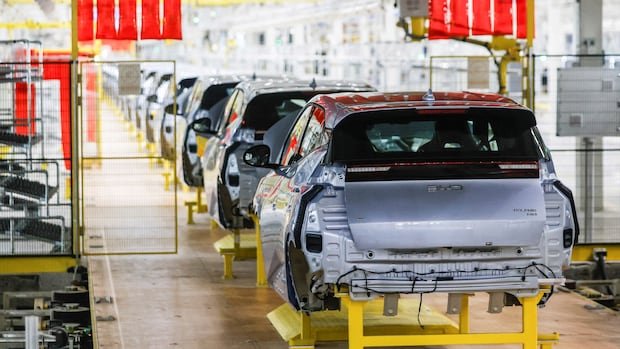

The Canadian market officially welcomed Chinese-made electric vehicles on March 1. However, it may take some time before popular brands like BYD or Chery EVs are seen on Canadian roads. Industry experts suggest that more established brands such as Polestar, Volvo, and Tesla will likely enter the Canadian market first.
Chinese electric vehicles, including well-known brands like BYD, Chery, and Geely, often offer lower retail prices due to cost-effective materials, inexpensive labor, and government subsidies. Despite this, non-Chinese brands like Volvo, Polestar, and Tesla, which also produce in China, could benefit from the recent EV agreement announced by Prime Minister Mark Carney in January.
While China produced 12.4 million EVs in 2024 and aims for annual global sales of 40 million vehicles in the coming years, there is a surplus of manufacturing capacity in Chinese companies. With a limit of 49,000 Chinese-made EVs allowed into the Canadian market at a 6.1% tariff rate, manufacturers will strategically select which models to export to maximize profits.
According to Peter Frise, a professor at the University of Windsor, the decision on exporting vehicles to Canada will likely favor higher-profit models due to the limited quota. He highlighted the potential challenges Chinese automakers face in deciding between exporting cheaper, less profitable vehicles or pricier, more profitable ones.
Addisu Lashitew, an associate professor at McMaster University, mentioned that Teslas, Polestars, and Volvos could arrive in Canada as early as this month or next, while newer Chinese brands may take longer to navigate the approval process. Streamlining these procedures could be beneficial for Canada to avoid delays in restoring market access for products like canola.
In terms of the approval process, vehicles manufactured in China must comply with Canadian safety regulations before being permitted for sale. Transport Canada’s Appendix G Pre-clearance Program facilitates efficient border processes for Canadian importers by registering foreign manufacturers that adhere to Canadian safety standards. This involves inspections of various vehicle components, which could take several weeks or months for completion.
While BYD has received clearance to sell taxis and buses in the Canadian market, it is uncertain how this status will impact future imports. Transport Canada and Global Affairs did not provide details on the approval timeline for imported vehicles. Chinese manufacturers like Chery and Xiaomi did not respond to inquiries about their approval applications, while Polestar indicated that they are monitoring the developments closely, although Tesla did not comment on the matter.