
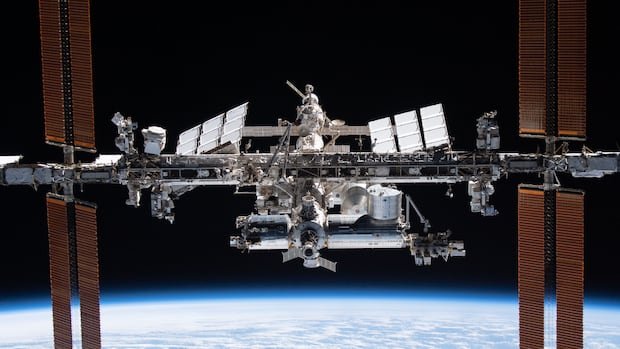

Historical structures like Alexander Graham Bell’s residence in Nova Scotia are often transformed into museums or national heritage sites to safeguard their legacy for future generations. But how do you conserve a building the size of a football field orbiting 400 kilometers above the Earth?
NASA’s official strategy is to bring the International Space Station (ISS) back to Earth at the end of its operational life by guiding it in a controlled descent into the planet’s atmosphere, where it will crash in a remote ocean area. However, this week, certain U.S. Government members introduced legislation urging NASA to reconsider this plan and explore the feasibility of keeping it in low Earth orbit instead.
Since the year 2000, the ISS has been continuously inhabited by astronauts and cosmonauts from various countries, including the U.S., Russia, Canada, Europe, and Japan. It was constructed incrementally through 36 space shuttle missions and six Russian Proton and Soyuz launches.
With a weight exceeding 400 metric tons, it stands as the most extensive scientific laboratory ever sent into space and has facilitated numerous experiments unique to a microgravity setting.
The ISS’s operational lifespan is drawing to a close. NASA disclosed in January 2022 that the space station would be retired by 2030 and deorbited in 2031. The current plan involves a SpaceX rocket propelling it on a trajectory to burn up upon reentry over a secluded part of the Pacific Ocean, mirroring the fate of its forerunner, the Russian Space Station MIR, which met a similar end in 2001.
However, some individuals are not convinced by this plan. On February 4, former NASA chief of staff U.S. Rep. George Whitesides proposed to the House Science, Space, and Technology Committee to investigate alternative options before committing the ISS to destruction. The motion passed the initial stage unanimously with bipartisan backing.
Whitesides emphasized the ISS’s significance as a pinnacle of human engineering achievement and questioned whether it would be prudent to ascertain the potential of preserving it in orbit for future generations.
Nonetheless, preserving the ISS poses challenges. The station cannot be left unattended for extended periods as it experiences atmospheric drag, necessitating regular boosts to sustain its orbit. Abandoning it would lead to an uncontrolled reentry within one to two years, similar to Skylab’s descent in 1979.
Boosting the ISS to a higher orbit for prolonged operation would demand substantial fuel and engineering considerations due to potential structural stresses and collision risks with space debris. NASA’s analysis in a 2024 report warned of catastrophic consequences from such an orbit, making low Earth orbit inaccessible for an extended period.
While private companies were invited to take over the ISS, no viable proposals were received, making the construction of new space stations a more feasible option. China’s Tiangong and upcoming private ventures like Haven-1 indicate the continuous trend of space station development.
Rep. Whitesides’ bill awaits further legislative steps, merely proposing an investigation into the viability of alternative approaches. Given the challenges and expenses associated with preserving the ISS as a heritage site, the likelihood remains that the $100 billion US space laboratory will meet its end incinerated in the upper atmosphere, with larger remnants sinking into the Pacific Ocean unless a superior solution emerges.