
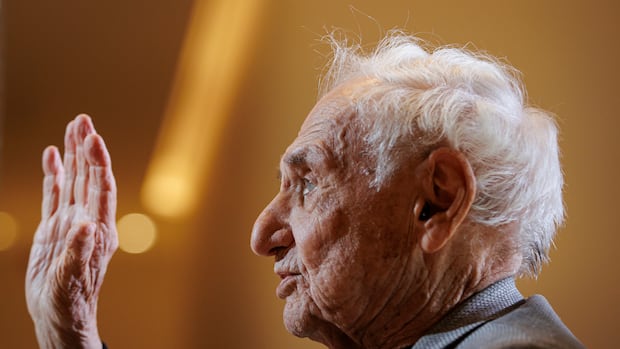

Frank Gehry, the innovative architect born in Canada and responsible for some of the most iconic structures globally, has passed away at the age of 96.
Meaghan Lloyd, chief of staff at Gehry Partners, LLP, confirmed that he died on Friday morning at his residence in Santa Monica, California, after a short illness.
Celebrated for his non-traditional style and bold designs, Gehry infused vibrant creativity into cultural institutions such as Toronto’s Art Gallery of Ontario, the Guggenheim Museum Bilbao in Spain, the Walt Disney Concert Hall in Los Angeles, and the Facebook headquarters in Menlo Park, California.
His distinctive projects spanning museums, commercial spaces, and private residences attracted an extraordinary level of attention, making his architectural works some of the most recognized worldwide. He even became a cultural icon, featured as a cartoon character in an episode of The Simpsons.
In 2012, while presenting his initial vision for a set of condominium towers in his native Toronto, Gehry remarked that facing criticism for his avant-garde designs was simply part of his role.
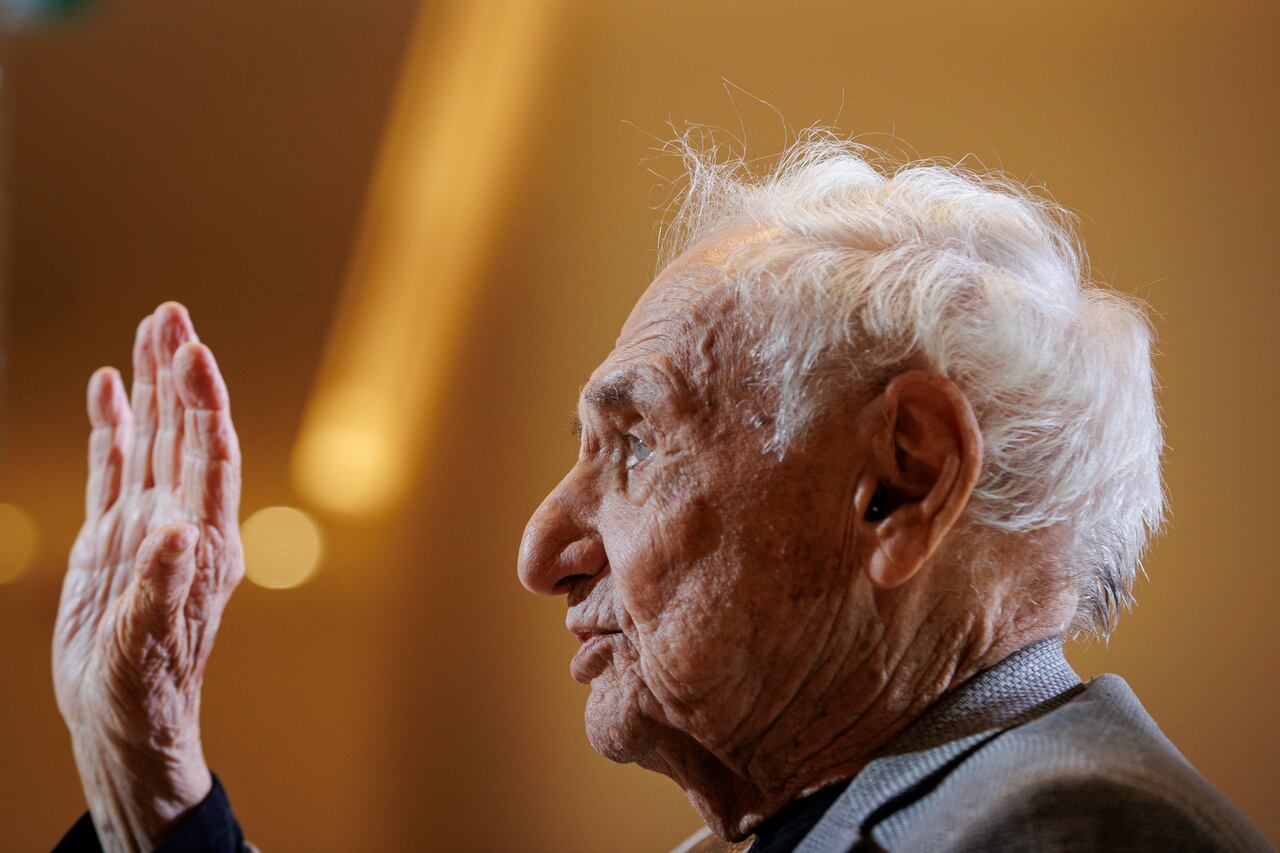
Renowned architect Frank Gehry has died at the age of 96. (Evan Mitsui/CBC)
When the models for the condominium project were revealed, they faced sharp criticism from some locals, prompting several redesigns before construction commenced. The updated blueprint for the ongoing project features two residential skyscrapers located in the city’s entertainment area.
“In Bilbao, Spain, they wanted to shoot me when they first saw the [Guggenheim design], and now the city enjoys $500 million annually in revenue. I don’t know how to deal with critics; it’s just part of the process,” he noted, recalling that the Walt Disney Concert Hall was also derided as looking like “broken crockery.”
Grandparents often credited as earliest influence
Born Frank Owen Goldberg on February 28, 1929, Gehry was the son of Polish immigrants in Toronto. His upbringing was deeply rooted in family values, with his grandparents often recognized as his earliest inspirations for his illustrious career.
His grandmother, Leah, would scatter uniquely shaped wood scraps purchased from a local furniture store across her kitchen floor, encouraging young Gehry to create imaginary buildings, bridges, and cities from them before they were tossed into the family’s wood stove.
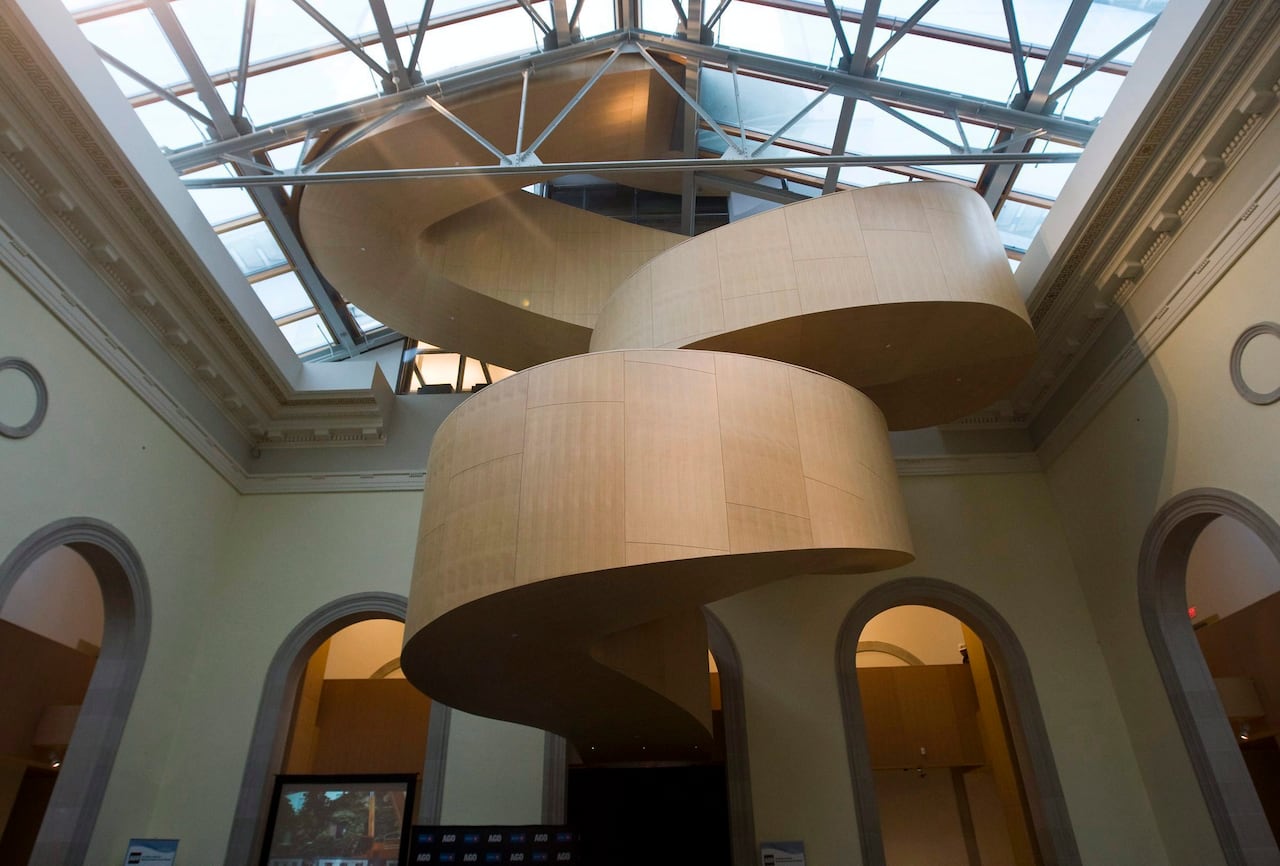
A photograph of a wooden staircase in the Art Gallery of Ontario in Toronto on Nov. 13, 2008, which was designed by Gehry. (Nathan Denette/The Canadian Press)
“It was the most enjoyable experience of my life. I realized it was a license to play,” Gehry is quoted in Paul Goldberger’s 2015 biography Building Art: The Life and Work of Frank Gehry.
As a teenager, Gehry attended lectures at the University of Toronto on Fridays and was particularly inspired by one speaker, whom he later believed to be Finnish architect Alvar Aalto, another modernist who gained recognition for defying conventions.
In 1947, Gehry and his family moved to Los Angeles, where he became a U.S. citizen three years later. During his initial years in the U.S., he worked as a truck driver by day while attending sculpture classes in the evenings, ultimately earning a degree in architecture from the University of Southern California.
Career began with a bang in Los Angeles
Reluctantly changing his surname in the mid-1950s at the request of his first wife, Gehry adopted the name to shield their children from potential antisemitism associated with the name Goldberg, a decision he later expressed regret over.
Those years were marked by professional instability as he navigated his ambitions alongside financial constraints and the challenges of raising two children. He served in the U.S. Army while cultivating connections within the architecture field on weekends and briefly studied urban planning at Harvard University before discontinuing his studies.
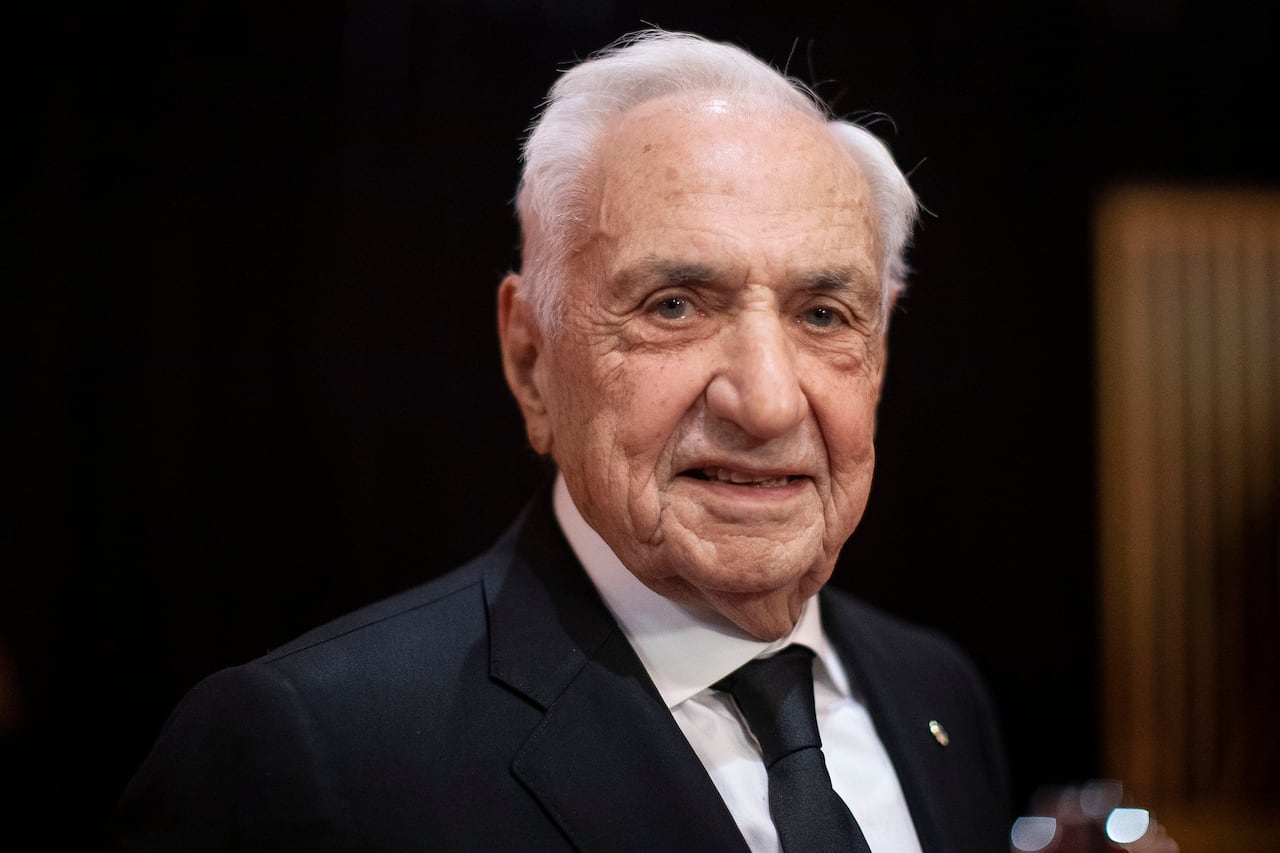
Gehry at a Canada’s Walk of Fame event in Toronto on Nov. 23, 2019. (Chris Young/The Canadian Press)
Gehry’s professional journey took off when he opened his Los Angeles office in 1962, followed by his work on the Danziger Studio and Residence, a well-regarded landmark in Los Angeles within two years. Most of his early projects adhered to modernist principles, emphasizing geometric lines and minimalism.
By 1967, Gehry’s standing within the architecture community soared. He was commissioned to design the Merriweather Post Pavilion, an amphitheater in Columbia, Maryland, which became his first project to gain coverage in the New York Times, which hailed it as “an unqualified architectural and acoustical success.”
During those formative years, Gehry concentrated primarily on projects in Southern California, including his inaugural shopping center, Santa Monica Place (1980); the Cabrillo Marine Aquarium expansion (1981) in San Pedro, California; and his own private residence, built in a deconstructivist style featuring materials like plywood planks, chain-link fencing, and corrugated steel (1978).
Designs took shape in cities around world by 1990s
As the 1990s approached, Gehry’s bold designs began to emerge in cities across the globe.
Notable projects like the Frederick Weisman Museum of Art, his Guggenheim Bilbao, and El Peix, a fish-like structure created for the 1992 Summer Olympics in Barcelona, epitomized his whimsical and unconventional design philosophy.
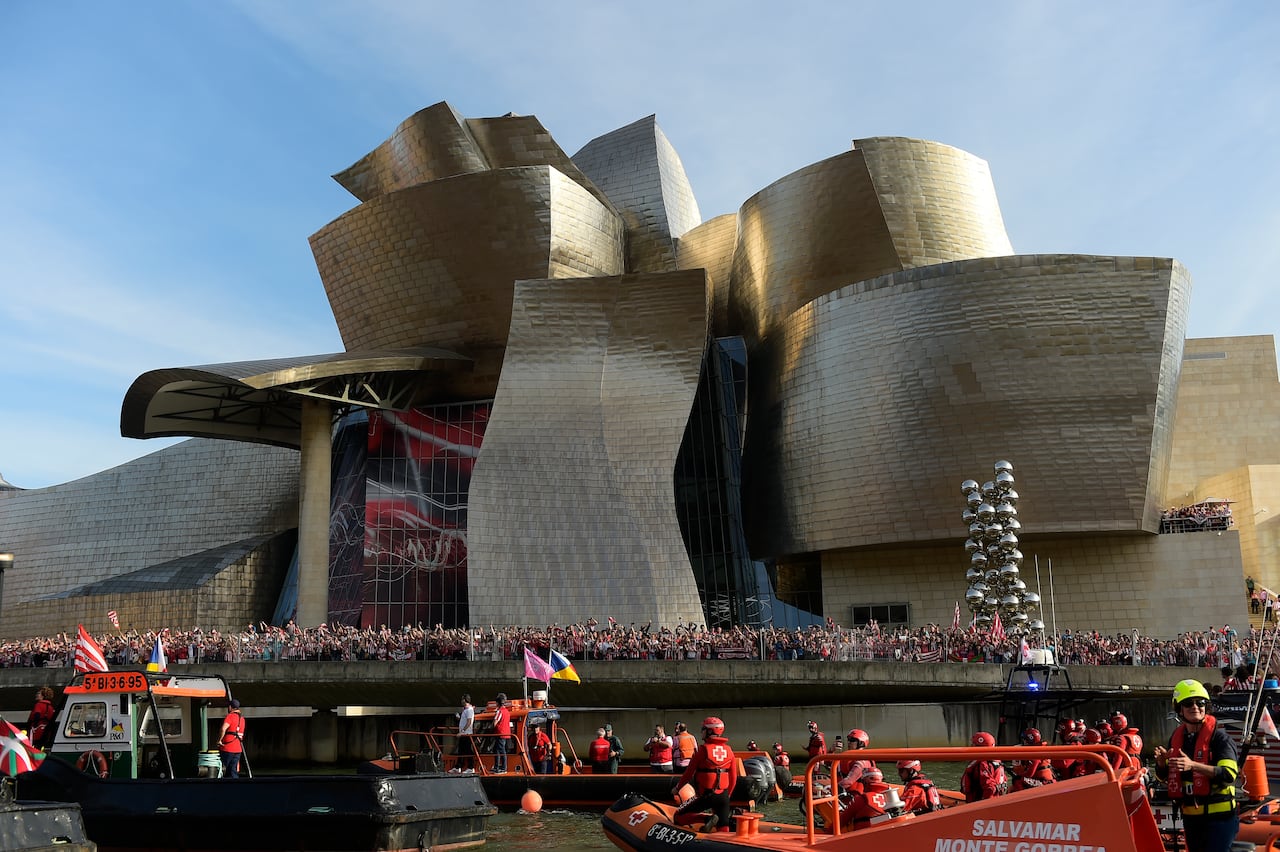
Athletic Bilbao fans wait in front of the Guggenheim museum as support boats pass before team celebrations on the Nervion Estuary in Bilbao, Spain, on April 11, 2024. (Alvaro Barrientos/The Associated Press)
When awarding him the prestigious Pritzker Architecture Prize in 1989, art critic and juror Ada Louise Huxtable commented that Gehry enabled joy to shine through in every structure he created.
“There’s nothing he has designed that doesn’t evoke a smile,” she stated. “These are designs that are lighthearted and vibrant, uplifting the spirit by demonstrating how the seemingly mundane can become extraordinary through imagination.”
While Gehry’s portfolio is extensive, other significant works include the redesign of the Art Gallery of Ontario in Toronto, the Gehry Tower in Hanover, Germany, and the Louis Vuitton Foundation for Creation in Paris.
Motivated by the lasting influence of his grandmother, Gehry sought to engage with the next generation of artists. He became involved with Turnaround Arts, a U.S. initiative led by the Kennedy Center aimed at enhancing the academic performance of underperforming schools through increased engagement in the arts.
Gehry awarded U.S. Presidential Medal of Freedom
Gehry was among those who led architecture classes for students often disengaged from traditional education. He provided them with tangible materials to stimulate their creativity, reminiscent of what his grandmother had done for him.
<p"You can engage them with painting and crafting—those tactile experiences," he explained in a 2019 interview with The Canadian Press.
“When they create a small building or a city… you can ask, ‘Who runs this city if you put them together?’ Thus, you can teach civics and various concepts. I believe my grandmother’s approach was spot on.”
In 2016, Gehry received the Presidential Medal of Freedom, the highest civilian honor in the U.S., awarded by then-President Barack Obama.
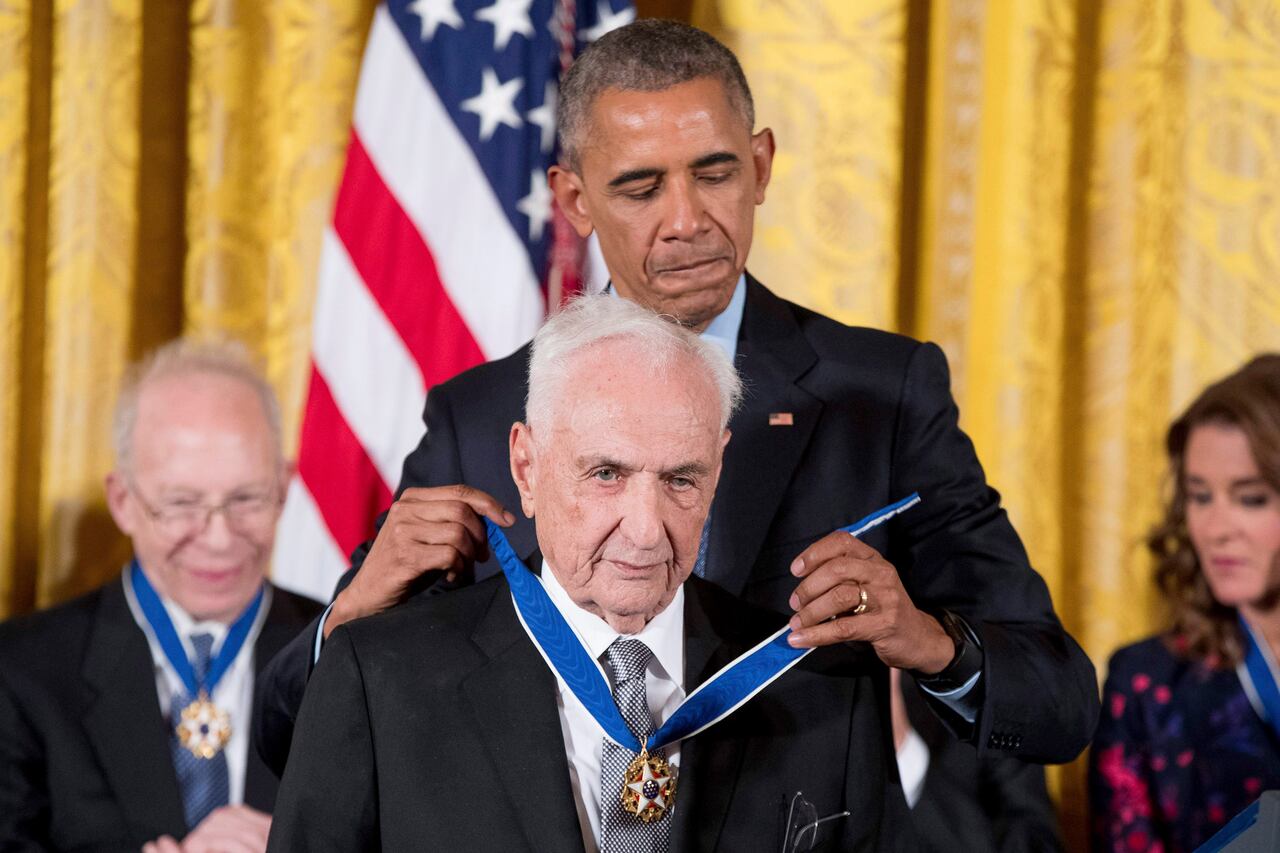
Gehry receives the U.S. Presidential Medal of Freedom from then-president Barack Obama during a ceremony at the White House, in Washington, D.C., on Nov. 22, 2016. (Andrew Harnik/The Associated Press)
During his address, Obama remarked that Gehry motivated others through his commitment to arts education and philanthropy.
“He chose to challenge the conventional wisdom of what architecture could be,” Obama stated. “Frank’s work teaches us that while buildings are solid and anchored to the ground, like all great art, they can elevate our spirits. They can rise and expand our perspectives.”
Canada’s Governor General Mary Simon and her husband, Whit, expressed their sympathies to Gehry’s family, friends, and those worldwide who have been inspired by his creations.
“The death of Frank Gehry signifies the loss of a true architectural giant on a global scale. Many regarded him as one of Canada’s most brilliant artistic figures,” Simon conveyed in her statement.
-
Frank Gehry started off building cities with his grandma
-
Frank Gehry returns to Canada to put his mark on the Toronto skyline
Simon noted that Gehry’s “visionary designs” transformed modern architecture.
“His creations did not merely occupy space; they challenged conventions, revolutionized urban environments, and left a lasting impact on how future generations engage with art and culture,” she stated.
“As a Companion of the Order of Canada, his legacy serves as a powerful reminder of the remarkable innovation and boundary-pushing creativity that originates in Canada and is shared globally.”
Prime Minister Mark Carney also conveyed his condolences via social media, stating, “Frank Gehry was an architectural legend whose audacious designs have influenced cityscapes around the world.”