
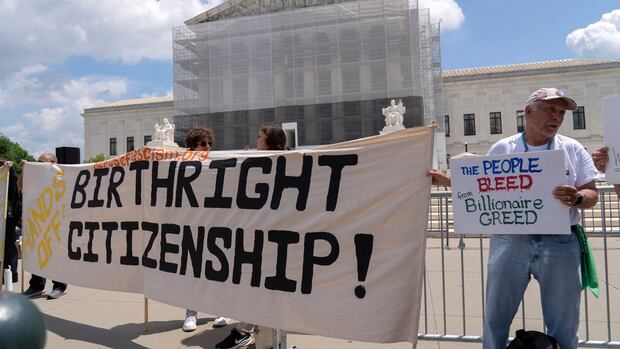

On Friday, the Supreme Court decided to review the constitutionality of President Donald Trump’s directive regarding birthright citizenship, which states that children born in the U.S. to parents who are undocumented or temporarily present are not American citizens.
The justices will consider Trump’s challenge to a ruling from a lower court that annulled these citizenship limitations. These restrictions have yet to be implemented anywhere across the nation.
The arguments for this case are scheduled for the spring, with a conclusive decision anticipated by early summer.
The birthright citizenship directive, signed by Trump on January 20, marking the start of his second term, is part of his administration’s extensive immigration enforcement efforts. This includes escalated immigration operations in various cities and the unprecedented peacetime application of the 18th-century Alien Enemies Act.
The administration is encountering several legal challenges, and the Supreme Court has issued mixed messages in its emergency rulings. Recently, the justices halted the use of the Alien Enemies Act for the swift deportation of alleged Venezuelan gang members without court hearings. Conversely, the Court permitted the resumption of extensive immigration checkpoints in the Los Angeles area following a lower court’s ruling that prohibited stops based solely on race, language, occupation, or location.
The justices are also considering the administration’s urgent request to allow the deployment of National Guard troops in the Chicago area for immigration enforcement, which a lower court has indefinitely blocked.
This is the first immigration-related policy from Trump to reach the Supreme Court for a final decision. If upheld, his order would overturn more than 125 years of interpretation that the 14th Amendment of the Constitution grants citizenship to anyone born on U.S. soil, with limited exceptions for the children of foreign diplomats and those born to foreign military occupiers.
In a series of rulings, lower courts have deemed the executive order unconstitutional or likely unconstitutional, even after the Supreme Court’s decision in late June that restricted judges’ abilities to issue nationwide injunctions.
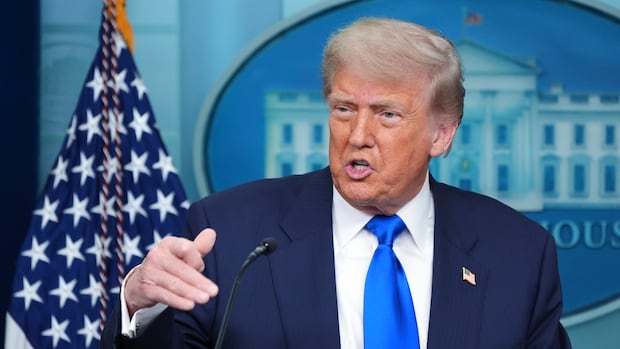
President Donald Trump stated that his administration can implement its priorities more swiftly due to the Supreme Court’s ruling on Friday. Trump has claimed that the laws regarding U.S. birthright citizenship were established during a period of slavery and are not relevant to current circumstances, a matter yet to be decided by the Court.
Nevertheless, the Supreme Court did not dismiss the possibility of other court rulings that might have nationwide implications, including those from class-action lawsuits and state filings. The Court did not determine at that time whether the citizenship directive itself was constitutional.
Every lower court that has deliberated on this issue has concluded that Trump’s directive violates or likely violates the 14th Amendment, which was designed to guarantee citizenship to Black individuals, including former slaves. Birthright citizenship automatically grants American citizenship to anyone born in the U.S., including children of mothers who are undocumented, according to established rules.
The case being evaluated originates from New Hampshire. A federal judge in July issued a ruling that blocked the citizenship directive through a class-action lawsuit representing all affected children. The American Civil Liberties Union (ACLU) is leading the legal efforts on behalf of the children and their parents challenging Trump’s order.
Cecillia Wang, the national legal director for the ACLU, remarked, “No president can alter the fundamental promise of citizenship enshrined in the 14th Amendment. We are eager to resolve this matter once and for all in the Supreme Court this term.”
The administration had also requested that the justices review a decision made by the 9th U.S. Circuit Court of Appeals in San Francisco. In July, that court ruled that a coalition of Democratic-led states suing over Trump’s directive required a nationwide injunction to avert complications arising from the implementation of birthright citizenship in certain states but not others. The justices did not take action in relation to the 9th Circuit case.

For over a decade, U.S. President Donald Trump has voiced his intention to eliminate birthright citizenship. On his first day back in office, Trump enacted an executive order aimed at excluding children of undocumented individuals from birthright citizenship entirely, a move that faced immediate legal challenges in courts nationwide. Recently, the U.S. Supreme Court granted Trump a significant victory by restricting lower courts’ authority to contest the President’s executive actions. Isabela Dias, an immigration journalist with Mother Jones, has extensively covered the topic of birthright citizenship and joins the program to discuss the implications of the Supreme Court’s ruling, Trump’s evolving definition of “citizen,” and the potential consequences of ending 160 years of birthright citizenship for all Americans.
The administration contends that children of noncitizens are not “subject to the jurisdiction” of the United States, and thus do not qualify for citizenship.
D. John Sauer, the administration’s leading attorney before the Supreme Court, stated, “The Citizenship Clause of the Fourteenth Amendment was established to confer citizenship on newly freed slaves and their offspring — not on the children of aliens present illegally or temporarily in the U.S.”
Support for the administration’s position comes from 24 Republican-led states and 27 Republican lawmakers, including Senators Ted Cruz of Texas and Lindsey Graham of South Carolina.