
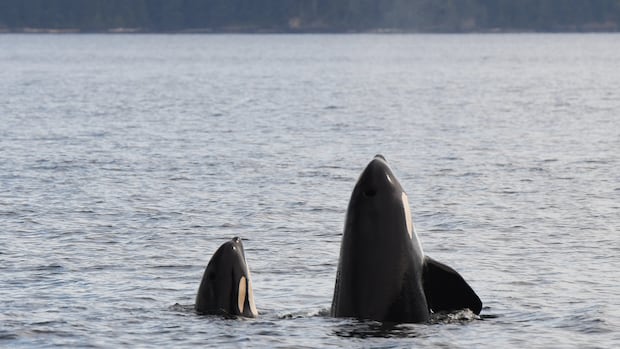

Pregnancy lasts about a year and a half, followed by up to two years of nursing. After that, orca mothers engage in hunting and sharing food with their adult offspring, who tend to remain with them indefinitely.
Orca mothers are incredibly dedicated.
According to biologist Sharon Kay, who authored recent research published in Scientific Reports, there is a significant long-term cost associated with raising offspring, as mothers invest extensive time caring for them throughout their lives.
The research examined body fat—a crucial indicator of survival for these marine mammals—and how quickly mothers can replenish it after giving birth. The key finding is that it is not the number of births that matters, but rather the number of surviving children present.
Experts suggest that these insights shed light on the societal pressures faced by orcas, particularly in light of ongoing human impacts on their habitats.
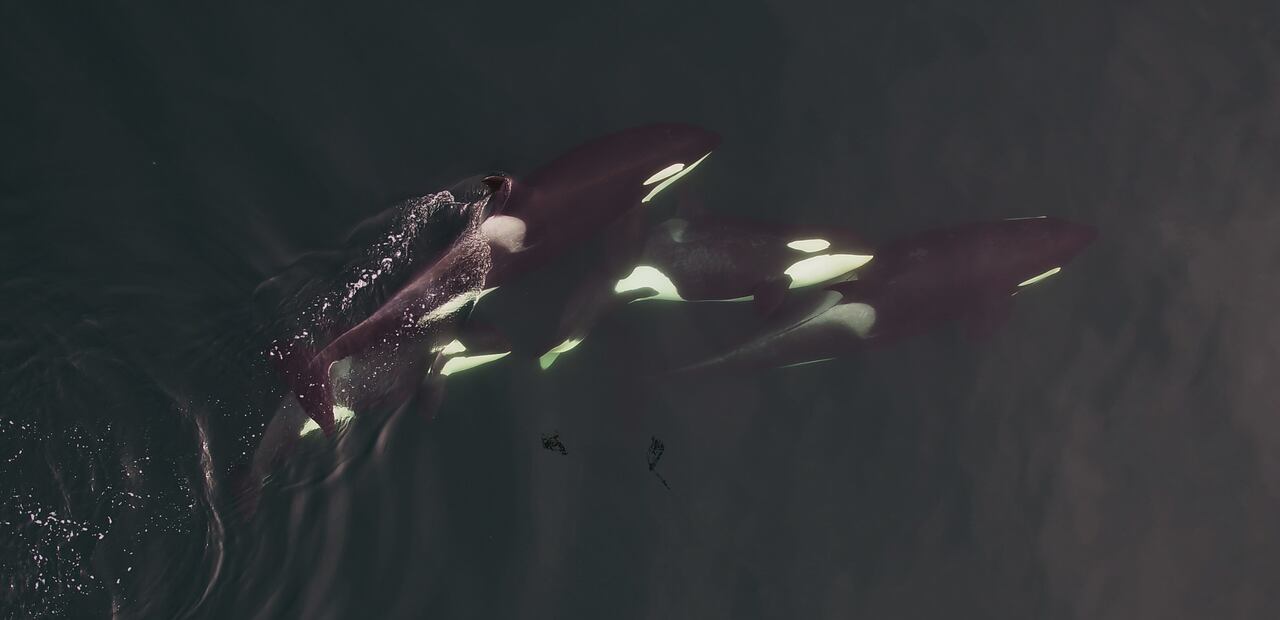
A pod of northern resident killer whales captured from above. Drone photography was utilized to assess the body conditions of adult females. (Ocean Wise, MML-18)
Precise pixel analysis
The research centered on northern resident killer whales, which inhabit regions from Alaska through the coastal waters of British Columbia and into northern Washington. These whales are also classified as threatened under the Species at Risk Act in Canada.
“Following childbirth and during the nursing period, there is a sharp decline in their fat reserves,” explained Amy Rowley, a co-author and biologist at the Raincoast Conservation Foundation. This decline can persist for approximately three years, and some mothers find it challenging to return to their pre-pregnancy state.
To unravel the reasons behind this, the team needed to assess body fat, but contrary to terrestrial animals, capturing and measuring wild orcas is not practical. Therefore, they resorted to using drones to photograph the whales from an altitude of 30 meters.
“The body condition of these killer whales primarily reflects the fat behind their heads, as that is the first area where they lose fat,” stated Kay, who conducted this research as a graduate student at the University of Victoria.

As the whales surfaced, their eye patches were analyzed through drone photography. (Gary Sutton/Ocean Wise/Raincoast Conservation Foundation, MML-18)
These images were meticulously examined, pixel by pixel, to assess alterations in the white patches above the whales’ eyes.
“If the eye patch appears more angled outward, that indicates a healthier and fatter whale,” Rowley explained. “Conversely, if they are more parallel or slightly angled inward, it suggests the whale lacks sufficient fat and may be in poor health.”
Surviving offspring count
The investigation of 66 adult females revealed that the most significant factor influencing body fat levels was the number of surviving offspring. (It’s noted that up to half of all killer whale calves do not survive beyond their first year.)
<p“It’s not solely the act of nursing and birthing that burdens the mothers; it’s the ongoing responsibility of locating fish and sharing that sustenance,” Kay remarked.
Hannah Myers, a marine ecologist from the University of Alaska Fairbanks, noted that this research contributes valuable insights into the intricate social dynamics of these animals.
“It’s thrilling to finally address some of these questions that were previously unanswerable without this kind of long-term monitoring and the innovative technologies now available,” Myers stated.

Recent findings published in Scientific Reports indicate that orcas and dolphins have been observed working together to catch salmon. Researchers noted that dolphins dive to pursue salmon while orcas listen in on their echolocation to hunt, allowing dolphins to feed on leftovers.
“This research presents some compelling findings, many of which closely align with our hypotheses about killer whale behavior,” stated Michael Weiss, research director at the Centre for Whale Research.
Interestingly, the current study on northern resident killer whales did not uncover evidence similar to what Weiss and his team observed in the endangered southern resident killer whales: that male offspring impose greater costs on their mothers compared to female offspring. However, Weiss clarifies that their focus was different.
“While our earlier research examined the final outcomes—how do they reproduce?—this study investigates the intermediate stage, which focuses on the changes in body condition,” Weiss explained to CBC News from the San Juan Islands in Washington.
One possible explanation for this inconsistency, Rowley proposes, could be that daughters tend to remain with their mothers—resulting in additional mouths to feed and placing more pressure on the mother, who may now also be a grandmother. Weiss noted that in the southern population, the reproductive rates are lower, potentially leading to fewer mouths to feed overall.
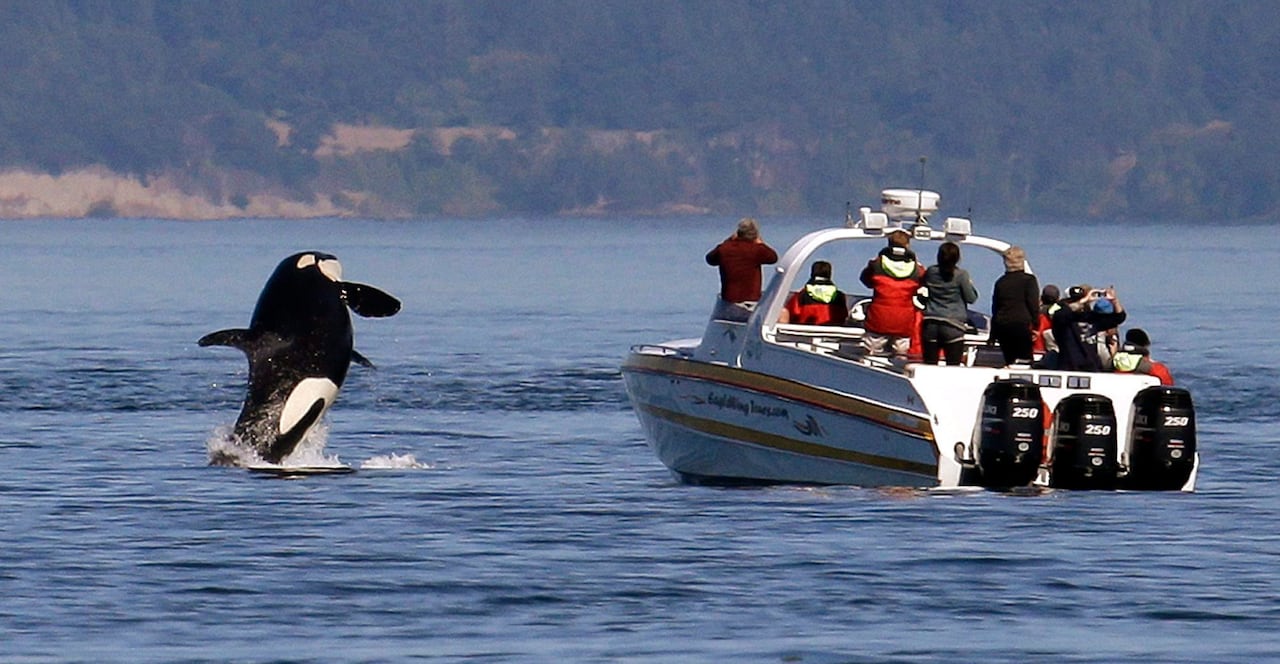
An orca leaps from the ocean while a nearby whale-watching boat observes in the Salish Sea in the San Juan Islands, Wash., in July 2015. (Elaine Thompson/The Associated Press)
Human and societal challenges
Understanding the effects on body condition is crucial, experts assert, due to the multiple challenges orcas encounter.
<p“This study highlights the significant role of maternal investment for any species,” Myers emphasized, noting that human impacts compound the challenges they face.
-
Orcas off B.C. coast face ‘high probability of extinction’ if conditions don’t change: report
-
Southern resident killer whales show signs of slow decline toward disappearance
These challenges include exposure to environmental pollutants, noise from shipping activities, and climate change that alters the distribution of their prey. Ultimately, this could lead to a further decrease in body fat—an indicator of mortality risk.
“They have a lot to sustain, so when we introduce additional stress through human activities, it exacerbates their already challenging situation,” Kay remarked.