
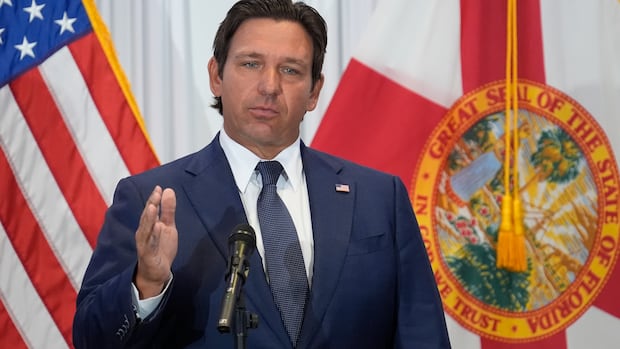

On Monday, Florida Governor Ron DeSantis officially classified one of the largest civil rights and advocacy organizations for Muslims in the U.S. as a “foreign terrorist organization,” mirroring a similar action taken by Texas the previous month.
This decision targeting the Council on American-Islamic Relations (CAIR) was made public through an executive order shared by DeSantis on X.
The directive mandates Florida state agencies to bar CAIR, along with the Muslim Brotherhood—which received the same designation on the same day—from securing contracts, employment, and funding from any state executive or cabinet agency.
In a statement sent via email, CAIR and its Florida chapter announced plans to file a lawsuit against DeSantis, calling the action “unconstitutional” and “defamatory.”
The organization responded defiantly on social media, stating, “[DeSantis] has become politically insignificant ever since Donald Trump handed him a humiliating defeat on the campaign trail. We will achieve the same outcome for Mr. DeSantis in a court of law, God willing.”
CAIR further accused DeSantis of prioritizing the interests of the Israeli government over the residents of Florida, though no details were provided.
Last month, CAIR sought intervention from a federal judge to overturn Texas Governor Greg Abbott’s proclamation, claiming in its lawsuit that it was “not only against the United States Constitution, but also lacks any legal backing in Texas law.”
Established in 1994, CAIR operates 25 chapters nationwide.
Since the events of September 11, 2001, the organization has been involved in numerous lawsuits against the federal government, advocating for individuals it believes were unjustly placed on the government’s secret terrorism watchlist. This watchlist is utilized by multiple government entities, and a subset of the database includes individuals banned from flying within the U.S.
Both Trump administrations presented unique challenges for CAIR, prompting the organization to file several lawsuits in response to various policy directives. This began with a legal challenge against a travel ban affecting citizens from several Muslim-majority nations, which caused significant disruptions at U.S. airports during Trump’s first week in office in 2017.
Recently, the group has criticized Trump’s derogatory remarks about Somali Americans, who are primarily based in Minnesota.
The second Trump administration has implemented wide-ranging measures to crack down on immigration, including heightened social media scrutiny and deportations of student visa and green card holders who have expressed support for Palestinians or criticized Israel’s actions in the Gaza conflict.
In September, CAIR honored one of those students, Mahmoud Khalil, with its Champions of Justice award for his leadership in anti-war protests at Columbia University.

Controversial speaker recently removed from U.S.
Recently, CAIR condemned the federal government after pro-Palestinian commentator Sami Hamdi was detained by Immigration and Customs Enforcement on October 26. The 35-year-old British national had spoken at the annual gala for CAIR’s Sacramento chapter the day prior to his arrest and later departed the U.S. voluntarily.
CAIR spokesperson Hussam Ayloush remarked at the time, “Sami’s situation illustrates how readily our government officials are willing to compromise our First Amendment rights and press freedoms when a journalist dares to prioritize America over Israel.”
Subsequently, the Department of Homeland Security accused Hamdi of endorsing the Hamas-led assaults on Israel on October 7, 2023. In late 2023, Hamdi had encouraged a London mosque to “celebrate the victory” following years of oppression.
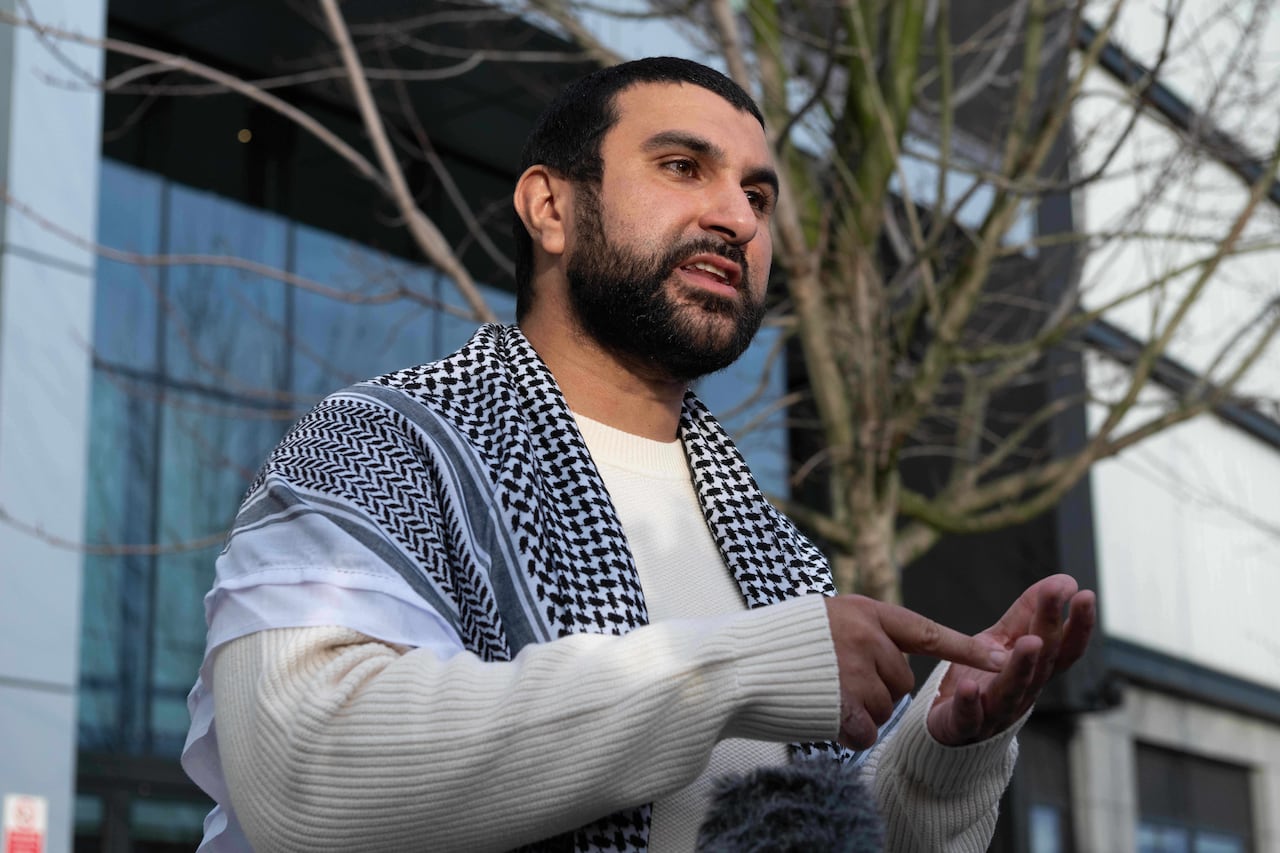
British political commentator Sami Hamdi speaks to the media in London on Nov. 13 on his return to the U.K. after he was arrested by Immigration and Customs Enforcement after appearing at a CAIR-sponsored speech. (Thomas Krych/The Associated Press)
Later, Hamdi clarified that his intention was not to glorify the attacks but to indicate that the violence was “a natural consequence of the oppression faced by the Palestinians.” Some Canadian universities canceled his planned speeches for early 2024, although at least one event proceeded as scheduled.
The Muslim Brotherhood was founded in Egypt nearly a century ago and has established branches globally. Its leaders assert they renounced violence decades ago, aiming to establish Islamic governance through elections and peaceful means.
However, critics, including authoritarian regimes across the Middle East, consider it a threat.
There are no specific Muslim Brotherhood chapters operating within the U.S.