
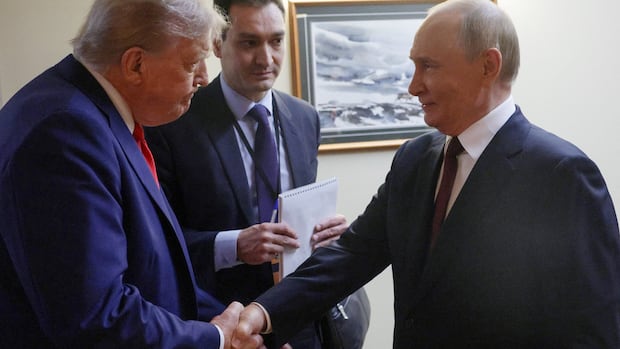

The recent national security strategy introduced by U.S. President Donald Trump seems to undermine several fundamental tenets established over the past 80 years regarding European collective defense, posing a challenge to the very foundation of the continent’s relationship with the United States.
However, many European nations will likely require further persuasion on whether the White House intends to, or is even capable of, implementing some of its more radical or transformative proposals.
In a scathing critique, Trump’s new policy characterizes European governments as weak and ineffective. It asserts that migration has eroded the continent’s self-assurance, accusing the European Union of contributing to a decline in national sovereignty, reduced political freedoms, and the lessened efficacy of individual nation states.
Notably absent from the document is any mention of Russia as an adversary or its role as the aggressor in the ongoing war against Ukraine.
The strategy does not assert that the primary U.S. interest should be in defeating Russia and reclaiming Ukraine’s territories; instead, it advocates for the pursuit of “strategic stability” with Russia.
In other sections, Trump’s strategy resembles a manifesto aimed at promoting the Make America Great Again movement in Europe, aligning with far-right parties like Germany’s AfD, particularly regarding the adverse effects of immigration, rather than serving as a conventional framework for upholding the shared values of closely connected allies.
Indeed, it seems to reverse the ally-adversary relationship by suggesting that the U.S. should focus on exerting pressure on Europe, “cultivating resistance” to its current path, rather than opposing Russia.
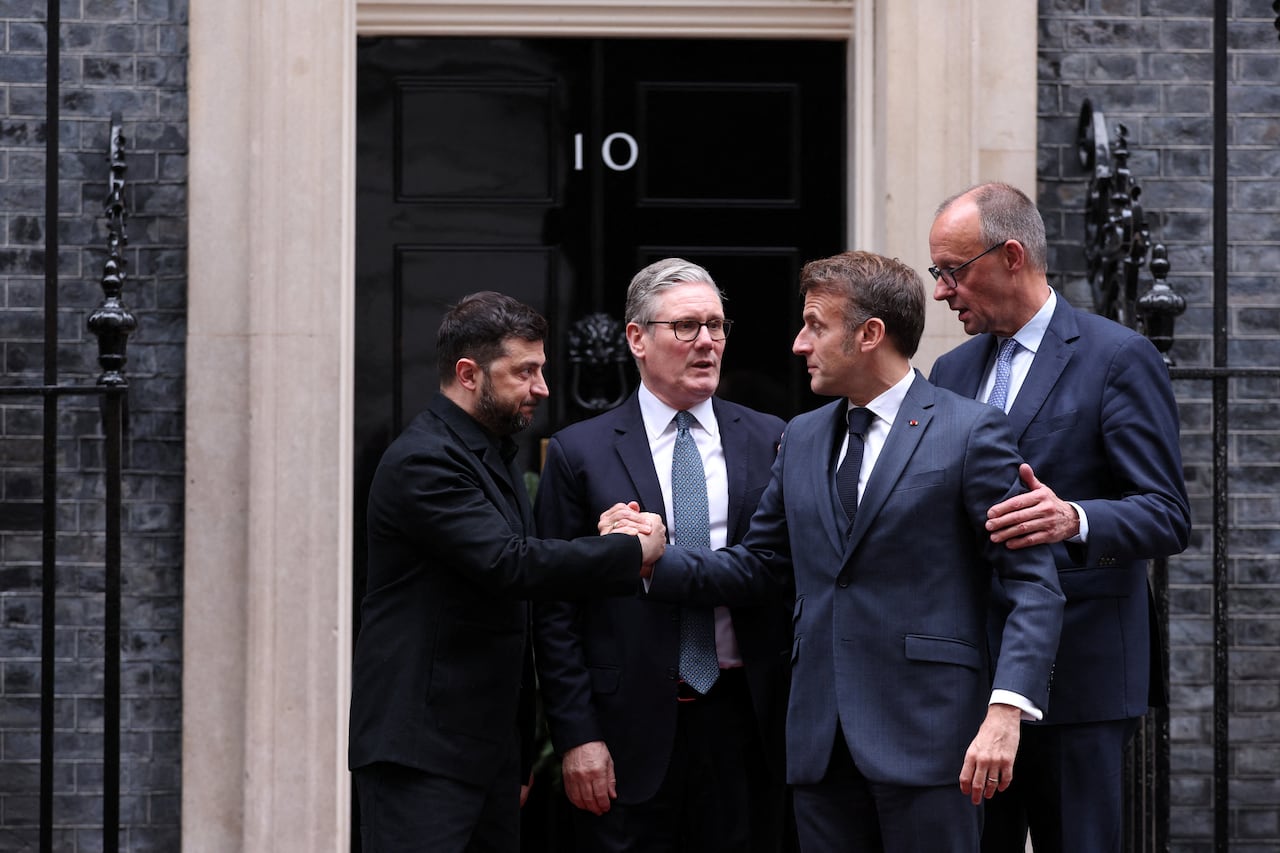
British Prime Minister Keir Starmer, Ukrainian President Volodymyr Zelenskyy, French President Emmanuel Macron, and German Chancellor Friedrich Merz chat outside 10 Downing Street following a meeting, in London on Dec. 8. (Adrian Dennis/Pool/Reuters)
Major Shift
Although the document reaffirms the U.S. commitment to NATO, it seems to perceive American responsibilities toward European defense as conditional and limited, marking a significant shift.
It states, “The days of the United States supporting the entire world order like Atlas are over.” This portrays the U.S. more as a mediator in resolving European disputes with Russia rather than as the continent’s most reliable supporter.
To many in Europe, this strategy appears to undermine the essential principle of collective defense that forms the backbone of NATO — that an assault on one member is an assault on all.
Numerous analysts assert that NATO’s Article 5 guarantee has been crucial in preventing conflict between alliance members and Russia since World War II.
However, in an interview with the BBC, Trump’s former EU ambassador Gordon Sondland remarked that if European nations wish to defend themselves against potential aggressions from Russian President Vladimir Putin, the responsibility should rest squarely on their shoulders.
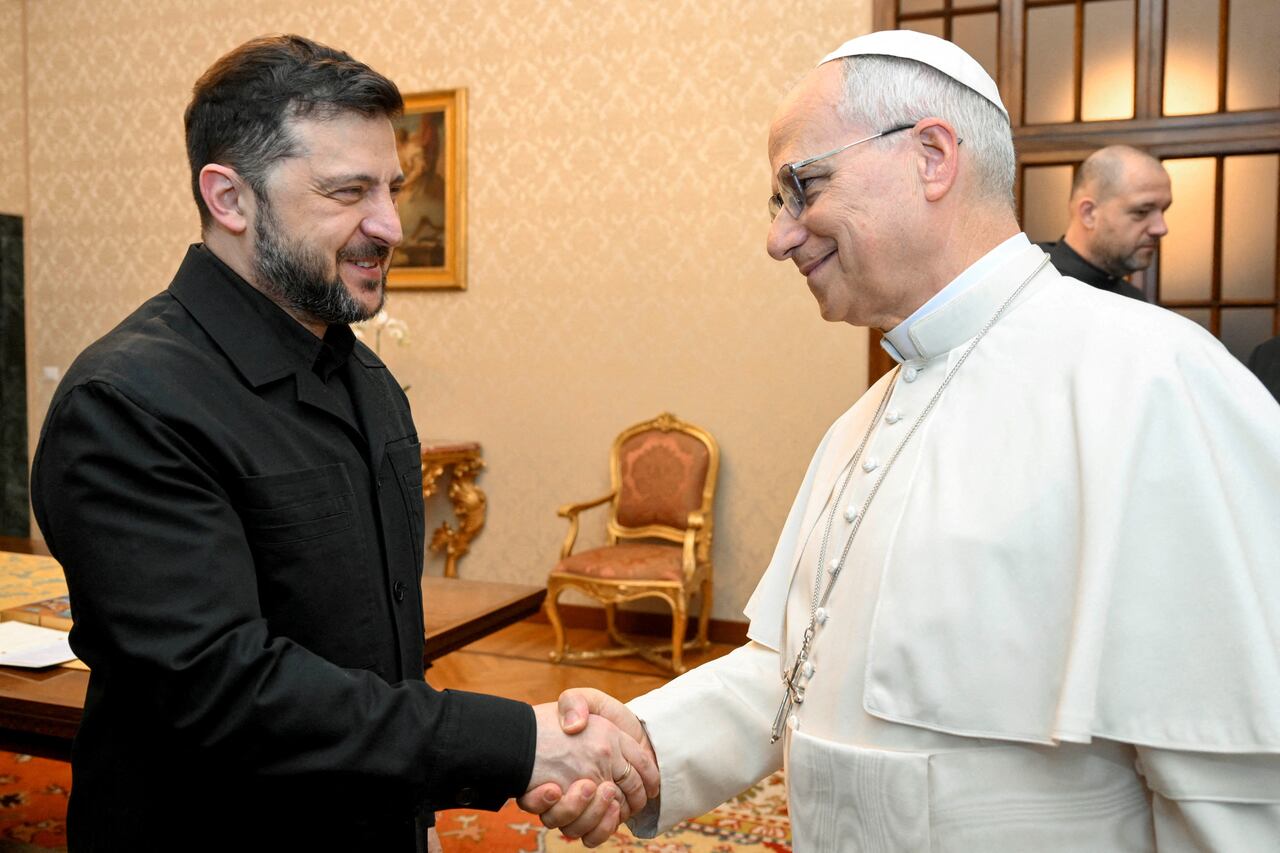
Pope Leo XIV and Ukrainian President Volodymyr Zelenskyy shake hands at Villa Barberini in Castel Gandolfo, Italy, on Dec. 9. (Vatican Media/ÂSimone Risoluti/Handout/Reuters)
“He [Putin] will attempt to strike again unless Europe finally steps up and establishes a significant barrier against him,” stated Sondland.
This entails increased defense spending and the commitment of resources and personnel, he added, “to demonstrate that Europe is prepared to engage in that kind of conflict with Putin, supported by the United States but not led by it. That’s the direction Trump is advocating.”
Recurring Themes
While the strategy’s tone and its existential critiques of the European Union are more pronounced than before, the core message of the document remains consistent.
U.S. Vice-President JD Vance set forth the initial premise of this so-called “America First” strategy during his notorious address at the Munich Security Conference earlier this year.
In the immediate aftermath of its release by the White House late Thursday, the document was met with a range of reactions, from profound concern to outright outrage among European security experts and some EU leaders.
Leslie Vinjamuri of the prestigious London-based think tank Chatham House remarked on a podcast, “This is Donald Trump drawing a line in the sand — the conclusion of the post-Cold War liberal international order.”
There was also indignation over Trump’s apparent attempt to influence European elections by opposing centrist or pro-EU parties.
António Costa, the Portuguese president of the European Council, asserted that the Trump administration has no authority to dictate to Europeans whom they should support at the polls.
“The United States cannot replace European citizens in determining which parties are right or wrong,” he stated.
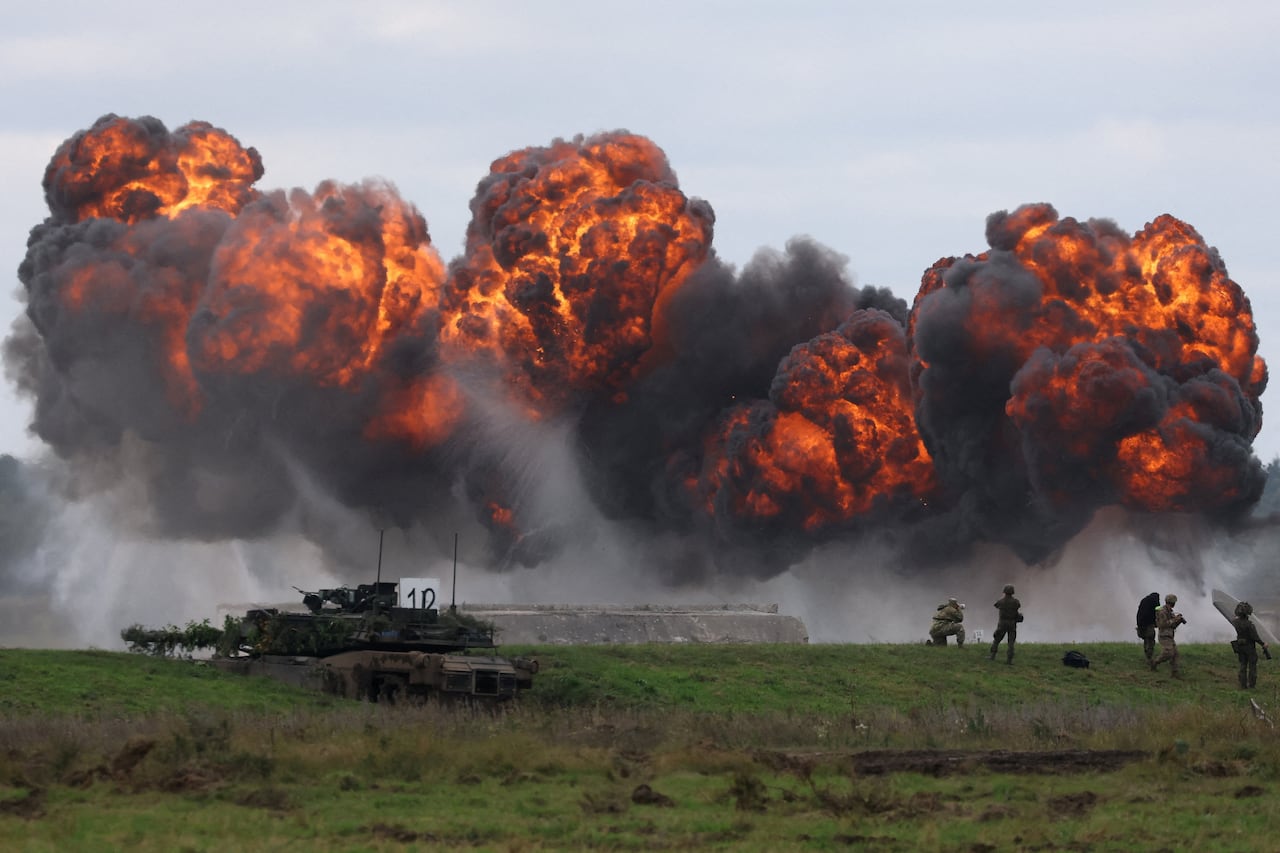
Smoke billows from a blast near Polish Abrams tank as Polish forces with NATO soldiers hold military exercises ‘Iron Defender’ at a military range in Wierzbiny near Orzysz, Poland, on Sept. 17. (Kacper Pempel/File Photo/Reuters)
‘Understandable’ and ‘Comprehensible’
However, as the initial reactions settle, much of that immediate criticism has lessened.
German Chancellor Friedrich Merz remarked that portions of the strategy were “understandable” and “comprehensible,” while simultaneously agreeing that Germany — Europe’s largest defense spender — needs to be “much more independent from the U.S. in terms of security policy.”
Polish Prime Minister Donald Tusk, a centrist, expressed opposition to the strategy, yet maintained a conciliatory tone.
“Dear American friends,” he posted on X, “Europe is your closest ally, not your problem. And we share common enemies. This has been the case for the last 80 years. We must adhere to this; it is the only rational strategy [for] our mutual security.”
Since the commencement of Trump’s second term, traditional U.S. allies, including Canada, have experienced insults, tariffs, and have been treated more like adversaries as he endeavored to reshape the global order to align with his “America First” ethos.
Generally, Europeans have refrained from vocalizing their frustrations, often resorting to flattery. The U.K. even hosted an extravagant state visit to keep the unpredictable U.S. leader on their side.
While two-thirds of NATO members, including Canada, have responded to the U.S. call for increased defense spending, EU nations have generally shown little inclination to adopt other elements of Trump’s agenda.

Anti-tank fortifications, known as ‘dragon’s teeth,’ and razor wire are established amid Russia’s assault on Ukraine in the Donetsk region, on Dec. 8. (Stringer/Reuters)
Aside from the United Kingdom, which voted to exit the union in 2016, no other member state has signaled a desire to leave the political and economic bloc. Even in nations with higher Euro-skepticism, such as France and Italy, such views remain in the minority.
European nations may also be refraining from pressing the panic button due to the document’s omission of numerous direct threats faced by the United States, making it difficult to gauge how much of a strategic framework it truly represents.
There is scant mention of cyberattacks from China. North Korea’s nuclear program and the associated risks for U.S. treaty allies Japan and South Korea are not addressed. Additionally, there are no references to the superpower competition regarding nuclear weapons or space.
Other analysts who spoke to CBC News indicate that there is likely considerable opposition within Congress and even among various factions of the Trump administration concerning several key points in the document.
“It’s hard to envision the United States relinquishing any semblance of true global authority,” stated Brandan Buck from the Cato Institute, a libertarian think tank based in Washington, D.C.
Buck indicated that while there may be a push within Trump’s MAGA base to withdraw as much as possible from global commitments, substantial Republican backing for NATO and collective defense persists, with the U.S. as a strong safeguard.
“Within the conservative movement’s institutions, I believe there is significant reluctance to make any drastic changes,” he added.
This situation may provide European leaders with reason to believe they can maintain their current course with Trump, perhaps waiting him out until the midterm elections or until 2028 when a new president takes office in the U.S.
Nonetheless, analyst Judy Dempsey, writing for the Carnegie Endowment for International Peace, cautioned that this might be the wrong strategy.
Dempsey argued that Trump’s document is accurate on several points.
“Europe does lack self-confidence. Yes, it has overly relied on the United States as a security provider for too long. Yes, it has neglected to heed the concerns of the far right.”
However, if European leaders are contemplating a significant reset in the wake of Trump’s directives, there is currently little evidence to support this.