
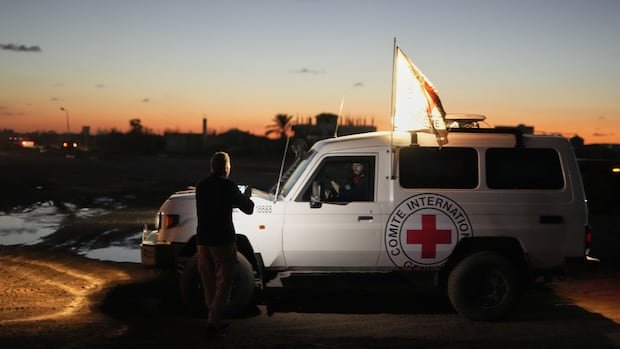

Israel confirmed on Tuesday that it had received human remains transferred by Palestinian militants to the Red Cross. However, it remains uncertain whether the remains belong to any of the three hostages still in Gaza. Prime Minister Benjamin Netanyahu’s office announced that the remains would undergo forensic testing for identification.
The Palestinian Islamic Jihad reported that the remains were discovered earlier in the week in Nuseirat, located in central Gaza. This transfer is part of the ongoing ceasefire agreement reached last month, despite both sides accusing each other of violations.
As per the October deal between Hamas and Israel, Hamas released all 20 surviving hostages in Gaza in exchange for around 2,000 Palestinian detainees held by Israel. The agreement also included the return of 28 hostages’ remains in exchange for the remains of 360 Palestinian militants.
To date, Palestinian militants have returned 25 hostage bodies, with the remaining hostages believed to include two Israelis and a Thai national. In response, Israel has released the bodies of 330 Palestinians to Gaza, most of whom remain unidentified.
Under pressure from Israel, Hamas claimed difficulties in retrieving all remains due to burial under rubble from Israel’s previous offensive. Israel accused the militants of delays and threatened military action or withholding aid if the remains were not promptly returned, deeming the delay a violation of the ceasefire.
In related developments, Egyptian state-affiliated Al-Qahera News TV disclosed that Egypt recently hosted a follow-up meeting for mediators and guarantors of the ceasefire deal. The meeting, attended by Egypt’s intelligence head, the Qatari prime minister, and the Turkish intelligence chief, aimed to discuss the implementation of the second phase of President Donald Trump’s post-war Gaza plan and address challenges, including ceasefire violations.
Furthermore, a Hamas delegation, led by exiled chief Khalil al-Hayya, engaged in talks with Egyptian officials in Cairo over the past two days to strategize on implementing future steps outlined in Trump’s plan. Since the ceasefire began on October 10, Israel and Hamas have exchanged blames for violations and resistance to subsequent steps mandated by Trump’s plan.