
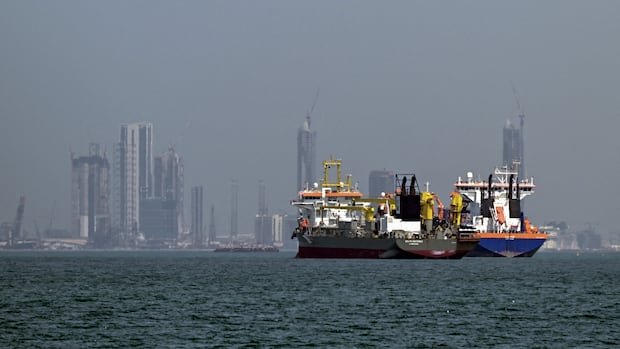

Amid the escalating tensions in the Middle East near the Strait of Hormuz, merchant vessels and their crews find themselves in a perilous situation.
Since the commencement of hostilities between the U.S., Israel, and Iran on February 28, thirteen ships have been targeted in the strait, resulting in the deaths of at least seven crew members, as reported by the U.K. Maritime Trade Operations Centre.
Phillip Belcher, the marine director for Intertanko, an association representing around 200 tanker owners globally, described the area as the most hazardous in the world currently. He emphasized that seafarers are experiencing high levels of anxiety.
Witnessing missiles flying overhead, crew members are uncertain about their safety, with the constant fear of being the next target while being defenseless on their vessels.
The Strait of Hormuz, bordered by Iran, has been a focal point of concern as Iran has threatened to block oil exports during the conflict. The heightened risks have led to a significant reduction in marine traffic, with only a fraction of the usual number of ships transiting the strait.
This disruption has effectively halted a crucial shipping route that serves as the sole sea passage from the Persian Gulf to the open sea.
Reports indicate that some vessels are altering their tracking data to appear connected to China in an attempt to lower the likelihood of being targeted. Additionally, certain ships are disabling their Automatic Identification System transponders to conceal their whereabouts.
Navigating through the narrow 32-kilometer-wide strait, characterized by a significant Iranian surveillance presence, poses a formidable challenge for the large tankers, making it nearly impossible to pass undetected.
Numerous Vessels Stranded
For nearly a fortnight, hundreds of ships have remained stranded in the Persian Gulf, impacting approximately 20,000 seafarers in the region, as per the International Maritime Organization.
Apart from oil tankers, cargo ships carrying various goods, food, and chemicals are also affected. Hapag-Lloyd, a prominent German shipping company, disclosed that they have six container ships anchored in the western part of the strait and are eager to navigate them out of the region.
The uncertainty of the situation, marked by heightened risks for the unarmed civilian vessels and their crew, has made it challenging for companies to plan their operations effectively.
Furthermore, negotiating new insurance policies has become necessary due to the increased perils associated with transiting the strait, resulting in soaring insurance rates.
Nils Haupt, the senior director of communications at Hapag-Lloyd, remarked that this situation represents a new chapter in commercial shipping history, with ships being targeted in a conflict for the first time.
Emerging Threat of Sea Mines
Although U.S. President Donald Trump proposed naval escort for safe passage across the strait, concerns persist as the protection measures have not materialized yet.
Belcher expressed doubts about the viability of the naval escort plan, citing the unfavorable conditions that could make naval ships vulnerable to missile attacks.
A new potential threat looms as American intelligence sources suggest that Iran may deploy sea mines in the strait, reminiscent of tactics used during past conflicts.
- <a class="cardWrapper-u5T0r cardWrapper-_487P noPaddingCardWrapper" data-feature-instance="similar-link" data-feature-name="link" data-contentid="9.7124916" aria-hidden="false" data-cy="type-link" href="https://www.cbc.ca/news/world/iran-sea-mines