

Last autumn, when Shelley Carr connected with a new match on Tinder who spoke passionately about art, politics, and theater, she believed she had discovered a genuine connection.
“I consider myself somewhat artsy. I enjoy attending plays, watching theater, and visiting art galleries, so I was looking for someone who shares similar interests,” she remarked.
“It felt like we had a lot in common, which is quite unusual.”
Eager to see if their chemistry would translate in person, she arranged an in-person meeting.
However, as soon as Carr spotted him stepping off the bus in Hamilton for their date, she sensed that the person she had been conversing with online didn’t match the individual who had just arrived.
Her suspicions were confirmed shortly thereafter when her date confessed that the articulate messages she had received were not his own work, but rather composed by ChatGPT.
Carr, who is 56, expressed her astonishment.
“I’ve encountered many different situations, but nothing like this.”
Carr’s experience illustrates how artificial intelligence is influencing the realm of online dating, and opinions vary on whether this is a positive or negative development.
Dating companies are eager to adopt AI technologies, introducing new features that aim to enhance the user experience. However, some users, particularly women, feel that these advancements are blurring the lines between reality and fabrication, complicating their search for love.
AI integration in dating apps
Regina Hay, a 24-year-old woman in Toronto, has been using dating apps for several years. Recently, she has noticed the pervasive presence of AI, not only in user profiles but also in the messages exchanged.
In February, she recalled having a promising conversation with a potential match until he sent her an elaborate theory about Spotify Wrapped that seemed too sophisticated to be his own.
When she pointed out the shift in tone, he confessed to utilizing AI, which left her feeling deceived.
“If I wanted an automated chat, I could just use ChatGPT myself. I reached out to him because I wanted to engage with that specific person,” she stated.
As ChatGPT-generated messages and third-party applications like RIZZ become more common, nearly all major dating platforms are integrating AI features to enhance user engagement and alleviate swipe fatigue.
Just about everything these days happens through cellphones, including dating, with users just a swipe and a match away from potentially finding a long-term partner. But some young people are breaking up with their dating apps, citing the desire to find more authentic connections and the strain of not getting the desired results.
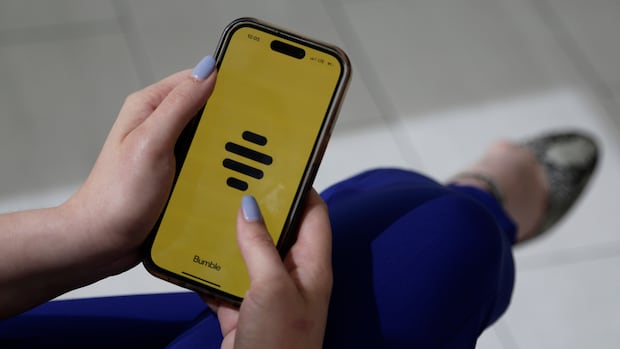
Bumble launched an AI-driven profile suggestion feature in February aimed at providing users with “personalized, actionable feedback” regarding their bios. Facebook also claims that its AI feature for its dating app can assist users in enhancing their profiles.
These AI features may prove beneficial, as the success of matches often hinges on how effectively individuals present themselves, according to Skyler Wang, a research scientist at Handshake AI and assistant professor of sociology at McGill University, who investigates the influence of digital platforms on relationships.
“With these generative AI tools, you essentially have an intelligent coach or guide that can assist in optimizing your behavior on the app and help you position yourself effectively within that ecosystem.”
Increased ambiguity
However, as individuals utilize AI to enhance their profiles and craft messages, discerning whether someone is a suitable match in reality becomes more challenging.
“The difficulty in accurately assessing someone’s authenticity or genuineness has increased significantly.”
Carr stated that this was her feeling upon discovering that her date had been leveraging ChatGPT.
“All the red flags that one would usually notice in a conversation were completely obscured because he was using ChatGPT.”
Dating apps have been struggling to keep users over the past few years, so to improve the experience, nearly every major dating platform is incorporating AI to help with everything from crafting your profile, to swiping/selecting for you, to writing the perfect first message. It’s transforming the dating app industry and Stephanie Tong, a Professor of Communication Studies at Wayne State University, says it’s also having an effect on how people form relationships.
If everyone resorts to AI for their dating profiles, it could lead to a uniformity in appearance, warns Eve Tilley-Coulson, a lawyer based in Los Angeles who operates a side business focused on optimizing dating profiles.
“It homogenizes the dating landscape … and leads to increased disillusionment, making users less inclined to engage with the apps since no one will stand out.”
Hall believes that employing AI for profile creation feels deceptive.
“I understand the reasoning, but for me, it removes the genuine experience of getting to know someone,” she expressed.
“While you may have instructed ChatGPT on topics to discuss and key points to mention, ultimately, the final product is not your creation, and it won’t reflect your voice.”
AI as a matchmaker
Certain companies are elevating the use of AI further by employing it in the manner of a sophisticated matchmaker, eliminating the need for extensive swiping.
One such service, Keeper.AI, requires users to complete an extensive questionnaire about themselves and their ideal partner, which is then processed by its algorithm to generate matches. The matches are subsequently reviewed by humans to ensure “genuine compatibility,” according to its website.
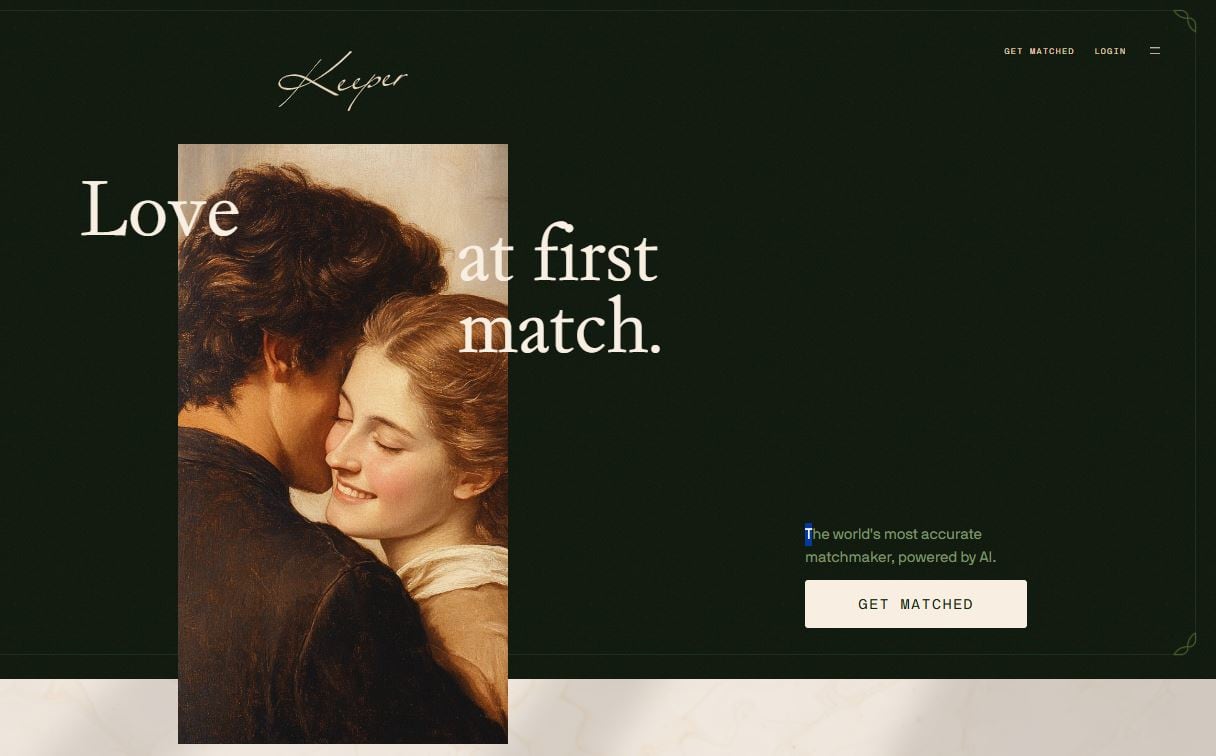
The Keeper.AI website claims to provide ‘the world’s most accurate matchmaker’ powered by AI. (Keeper.ai )
“We provide matches only when we are highly confident that they could lead to meaningful connections,” stated Keeper.AI‘s CEO and founder Jake Kozloski.
“It’s all about quality over quantity, which is quite different from what I would argue is the norm in this industry.”
Kozloski contends that traditional dating apps like Hinge fail to effectively assist individuals in finding long-term relationships, as they do not allow sorting through potential matches based on deeper criteria.
“Using these apps is akin to playing a slot machine when searching for a long-term partner, which can be incredibly frustrating. Finding a meaningful relationship is one of the most significant pursuits in our lives, and so far, technology has not addressed it adequately,” he remarked.
“That is the motivation behind creating Keeper, to actually develop a solution that works for this issue.”
Facebook’s AI “assistant” feature for its dating platform also offers users “personalized guidance” for discovering better matches.
This assistant allows users to refine their search parameters beyond standard traits typically found on dating platforms, such as age or educational background, enabling them to enter “unique prompts” that align closely with their preferences.
-
How dating apps frustrate you into paying for them
-
This is why you’re burnt out from using dating apps
“For instance, you could specify ‘Find me a tech-savvy girl from Brooklyn,’ and the dating assistant will assist you in your search,” a news release regarding the new feature explained.
Tilley-Coulson expressed her concern that utilizing AI as a matchmaker may strip online dating of its romantic essence.
“I believe AI is pushing the gamification and commodification of love to the extreme,” she stated.
“If you are seeking a partner who meets your specific criteria, it may be helpful for that. However, if what you’re after is to fall in love, it’s likely to be the opposite of that.”